|
Berlin is a city
with a long and rich history. The combination of old and new makes it vibrant
and complex, steeped in culture and enhanced by the best of modern technology.
As the political center of Germany, Berlin is the home to the Reichstag (seat of
the German parliament), remnants of the Berlin Wall, and historical treasures
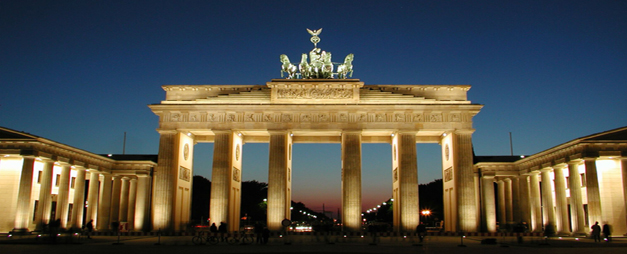
like the Brandenburg Gate, a symbol of unity and peace. Although much of the
city has been rebuilt, there is an ongoing effort to maintain and restore
historical monuments and buildings.
Berlin is also the capital of culture in Germany and plays a major role in
European culture. The city is home to countless museums, from the Ägyptisches
Museum and papyrus collection to the many alternative and local museums and
galleries. If theater is more to your taste, the Mitte (city center) district
boasts over a dozen theaters, from cabaret to opera, and from avant garde to
classical ballet.
The primary language spoken in Berlin is German, but most German people,
especially those living in large cities or working in the travel industry, speak
at least one other language, very often English, French or Italian. In a city
the size and importance of Berlin, it is not at all unusual to find many of the
world’s greater languages spoken easily and fluently, largely making
communication easy and simple.
Shopping opportunities in Berlin are many and varied. Everything from local
artisan-produced products to the latest in international couture is available in
the extensive shopping districts throughout the city.
From the old to the new, from local traditions to international possibilities,
Berlin has it all. We hope you enjoy your stay in this wonderful city!
Airports: Berlin has three airports, Flughafen Tegel, Flughafen
Tempelhof and Flughafen Schönefeld. Most flights from the United States and
Western Europe land at Tegel, while Schönefeld receives many Eastern European,
African and Asian passenger flights as well as international air carriers. All
three airports are connected to Berlin’s extensive public transportation
network.
Climate: The weather in Berlin in May is usually very nice, with
average highs of 18 degrees C, lows of 14C and 2.2 inches of precipitation on
average. Expect it to be cool, and for the most part pleasant, with occasional
rain showers. Up-to-date weather information is available at
www.germany-tourism.de.
Currency: As a member of the European Union, Germany’s currency is
the Euro, an international form of currency used by the entire EU. It is of
interest to note that while all Euros are accepted in all EU nations, every
nation issues its own version of the currency, with a country-specific design on
one side and the standardized EU design on the other. Most banks and government
offices are open for business from 8:30 to noon and 14:00 to 16:00, and are
closed Saturday and Sunday. Cash is available around the clock from cashomats
with EC cards and international credit cards. EC cards and credit cards
(American Express, Visa, Diners Club, Eurocard, MasterCard) are accepted
virtually everywhere.
VAT:
Please click here for IMPORTANT information regarding Value
Added Tax.
Public Transportation: Berlin’s public transportation network is
extremely accessible and the largest compound public transport network in
Germany. Comprised of the U-Bahn (underground),
S-Bahn (local trains), intercity
trains, trolleys and busses, it is designed in such a way that one should never
have to drive if one so wishes. Berlin is divided into three zones which have
different transportation fares. The inner city locations are in the A and B
zones, while the more peripheral destinations are designated as B and C. Tickets
can easily be purchased 24 hours a day at automatic ticket machines located at
public transport stations throughout Berlin. The automatic interface is
available in six different languages making travel within the city not only
cheap but also easy, no mater what language one prefers. Please
click here for additional information
on getting to the ICC Berlin and the public transportation system.
Visas: All visitors coming from outside Germany must have a
passport into Germany that is valid for at least four months after international
travel concludes. Additionally, entry visas are required for travel from some
countries. The visa application process must be started as soon as travel to
Germany is considered, and at least three to four months in advance of the
departure date. Please verify the entry documents necessary by contacting your
local German consulate office, or your local travel agent. Further visa
information is available on the visa information page of the ISMRM web site (http://www.ismrm.org/07/visa_info.htm)
Please review this information carefully to determine whether or not you
need to apply for a visa.
Voltage: Main electricity is 230 V and requires a double round
plug. Most foreign appliances and electronics will need an adapter plug, and
some will require a voltage converter, depending on the country for which the
appliance was designed. Furthermore, many German outlets are recessed into
the wall, so be sure that adapters are designed to match. |