Jun Chen Li1,2, Yu Liu1, Yongsheng Chen3, Zhijia Jin1, Naying He1, Weibo Chen4, Fuhua Yan1, and Ewart Mark Haacke1,5,6
1Radiology, Ruijin Hospital, Shanghai, China, 2Radiology, Changshu Hospital Affiliated to Nanjing University of Chinese Medicine, Changshu, China, 3Neurology, Wayne State University, Detroit, MI, United States, 4Philips Healthcare, Shanghai, China, 5Radiology, Wayne State University, Detroit, MI, United States, 6Biomedical Engineering, Wayne State University, Detroit, MI, United States
1Radiology, Ruijin Hospital, Shanghai, China, 2Radiology, Changshu Hospital Affiliated to Nanjing University of Chinese Medicine, Changshu, China, 3Neurology, Wayne State University, Detroit, MI, United States, 4Philips Healthcare, Shanghai, China, 5Radiology, Wayne State University, Detroit, MI, United States, 6Biomedical Engineering, Wayne State University, Detroit, MI, United States
Using known tissue
properties for spin density and T1, we show that MTC contrast of neuromelanin
(NM) can be significantly enhanced over current imaging methods and,
subsequently, the data can be collected with higher resolution with clear
depiction of the NM throughout the substantia nigra.
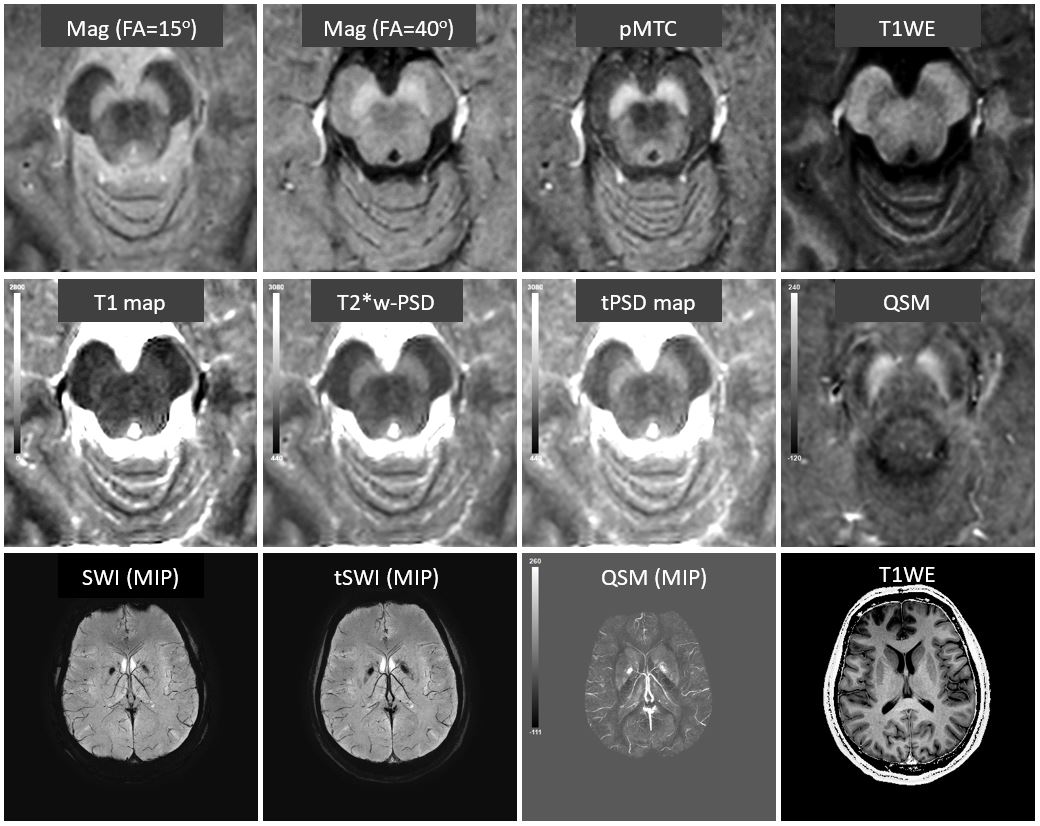
Figure 1. Representative
images from MTC-STAGE for a 30 year old healthy male. Two scans were acquired
with MTC: FA=15° and FA=40°. The product of these to MTC
images (pMTC) gives a compromise exhibiting good contrast in both the upper and
lower regions. Meanwhile, the STAGE processing gave SWI, tSWI, QSM and a T1WE
image (neither of the two FA MTC datasets gave T1W images) as well as four
quantitative data sets: a T1 map, T2* weighted PSD map, true-PSD (or tPSD) map,
and QSM. The T1 map and PSD maps demonstrated that the MT contrast mainly occurs
because of the high proton spin density in the NM.
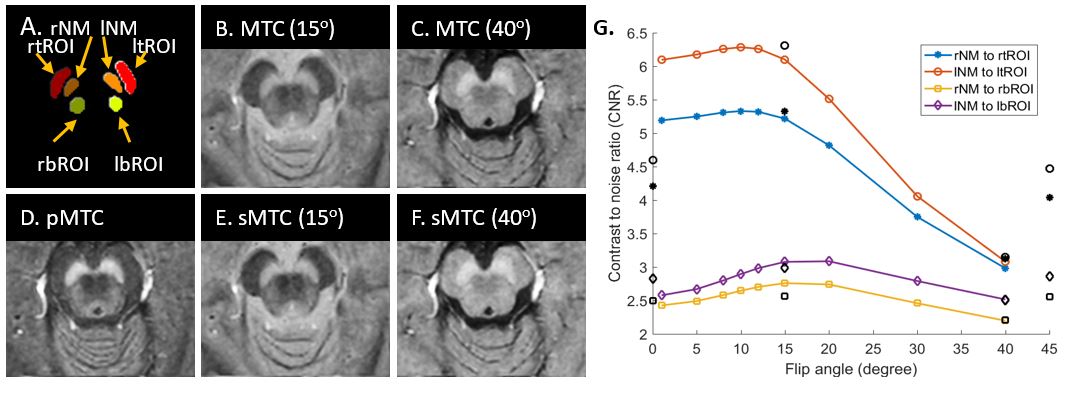
Figure
3. CNR
for the acquired and synthetic MTC (sMTC) images. The T1/PSD maps were
generated from the MTC 15° (B) and 40° (C) images. The sMTC images were generated
using the Ernst equation. Six ROIs (A) were manually drawn on left/right NM
(rNM, lNM), and homogenous regions on the top/bottom of the NM regions for both
sides (ltROI, rtROI, lbROI, rbROI) on the 20th slice. CNR was measured between
the NM and the adjacent tissues (right side rNM and right-top rtROI). On the
plot (G), the real data are shown in black and pMTC (spMTC) data at the origin
(45°) both are in agreement with the predictions.