Hyunyeol Lee1, Dongyeop Han2, Cheng-Chieh Cheng1, and Felix W Wehrli1
1Radiology, University of Pennsylvania, Philadelphia, PA, United States, 2Electrical and Electronic Engineering, Yonsei University, Seoul, Korea, Republic of
1Radiology, University of Pennsylvania, Philadelphia, PA, United States, 2Electrical and Electronic Engineering, Yonsei University, Seoul, Korea, Republic of
Issues in current R2' measurement techniques:
1) spin-echo-based -> long imaging time for 3D extension
2) Intrinsic magnetic field gradient induced signal loss and estimation errors around deep gray matter structures.
Proposed solution:
1) Alternating SSFP-FID and SSFP-ECHO
2) z-shimming
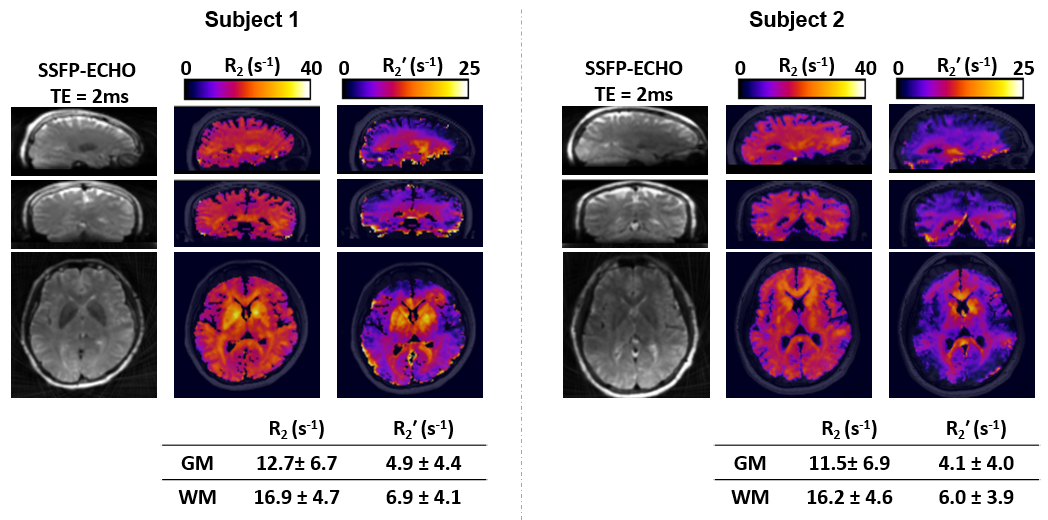
Figure 4. Derived R2 and R2’ maps in the three orthogonal
planes, along with SSFP-ECHO images at TE = 2 ms (last echo) in the two
subjects. Regional averages of the two parameters are given at the bottom. Note
high values of both R2 and R2’ in deep GM structures where SSFP-ECHO images
exhibit low signal intensities.
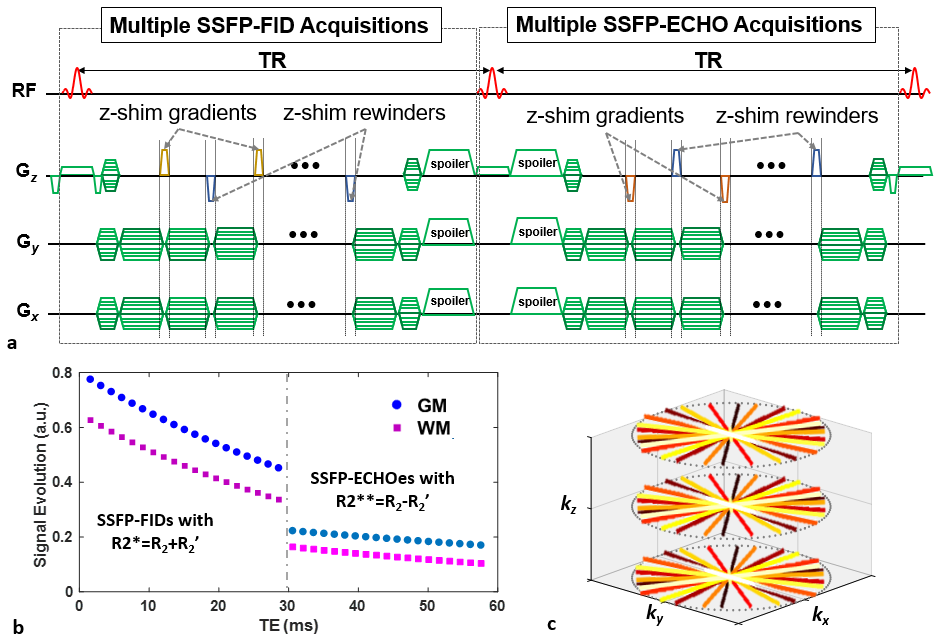
Figure 1.
a: Timing diagram of the proposed, alternating, 3D z-shimmed, unbalanced SSFP
pulse sequence. SSFP-FID and SSFP-ECHO modules are alternating along the entire echo train, within each of which multiple gradient-recalled echo signals are
acquired at varying TEs. B: Simulated signal evolution that can be described in terms of rate constants, R2* and R2**, in the SSFP-FID and SSFP-ECHO readouts, respectively. C: a stack-of-stars
k-space trajectory, in which kz encoding is performed in a Cartesian grid while
in-plane data is acquired in a golden-angle radial sampling manner.