Daiki Tamada1, Xiaoke Wang1, Timothy J. Colgan1, Diego Hernando1,2, and Scott B. Reeder1,2,3,4,5
1Radiology, University of Wisconsin-Madison, Madison, WI, United States, 2Medical Physics, University of Wisconsin-Madison, Madison, WI, United States, 3Biomedical Engineering, University of Wisconsin-Madison, Madison, WI, United States, 4Medicine, University of Wisconsin-Madison, Madison, WI, United States, 5Emergency Medicine, University of Wisconsin-Madison, Madison, WI, United States
1Radiology, University of Wisconsin-Madison, Madison, WI, United States, 2Medical Physics, University of Wisconsin-Madison, Madison, WI, United States, 3Biomedical Engineering, University of Wisconsin-Madison, Madison, WI, United States, 4Medicine, University of Wisconsin-Madison, Madison, WI, United States, 5Emergency Medicine, University of Wisconsin-Madison, Madison, WI, United States
Phase errors induced by motion may lead to underestimation of
T2, when using a gradient echo phase-based T2 mapping method.
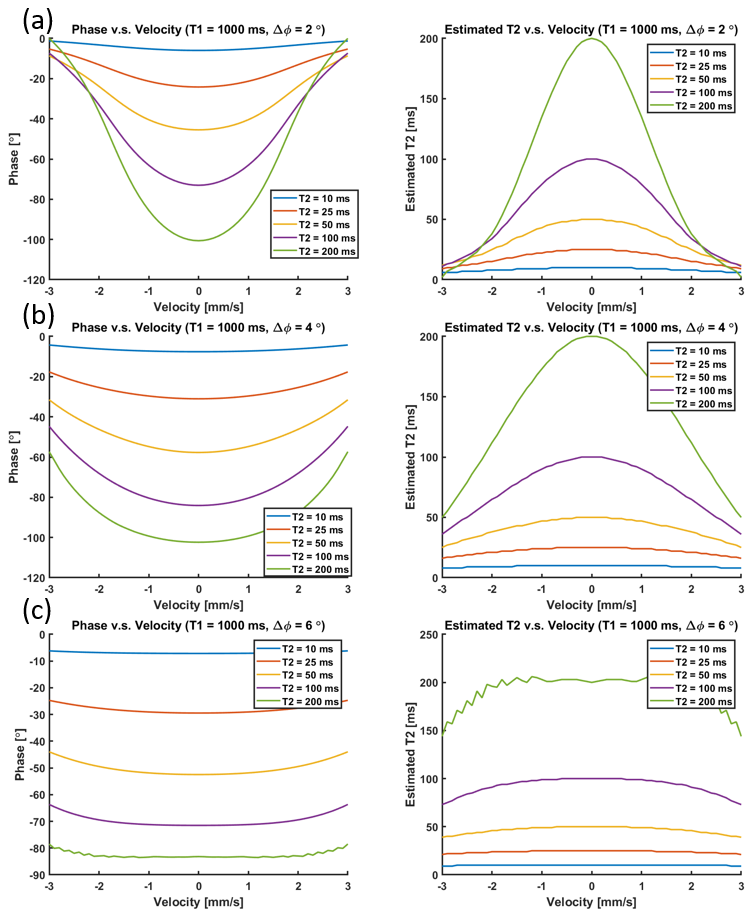
Fig. 3 Phase change
and T2 estimation error induced by linear motion with $$$\Delta \phi$$$ of (a) 2°, (b) 4°, and (c) 6°.
Phase of signal became less sensitive to the motion as larger Df
was used.
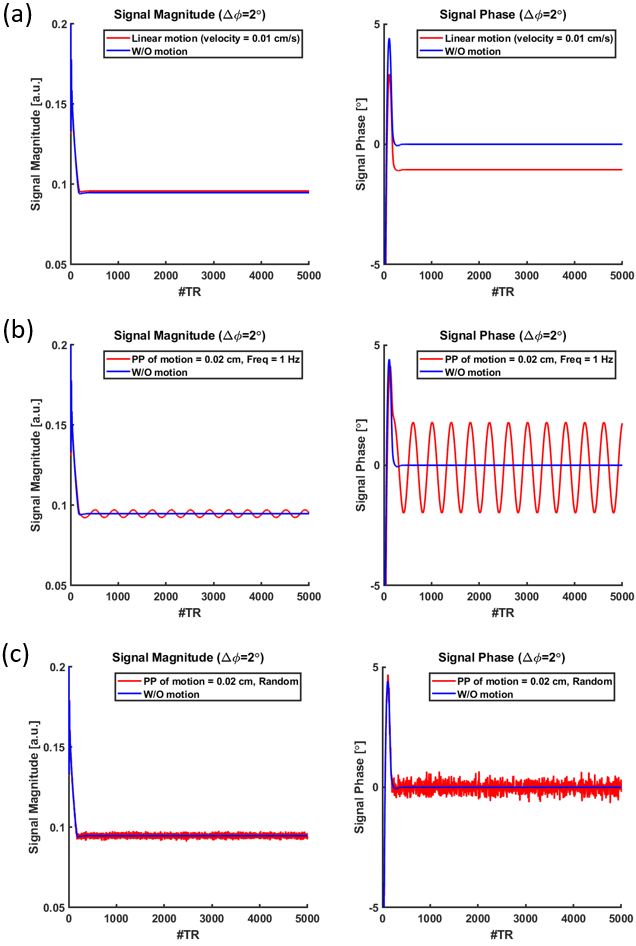
Fig. 2 Signal evolution with (a) linear, (b) sinusoidal, and (c) random motion calculated using Bloch simulation. The linear motion gave a non-negligible phase bias, while the sinusoidal and random motion caused oscillating and random errors in both magnitude and phase of the signal.