Rita G. Nunes1, Santiago Sanz-Estébanez2, Joseph V. Hajnal3, Lucilio Cordero-Grande3, and Carlos Alberola-López2
1ISR-Lisbon/LARSyS and Department of Bioengineering, Instituto Superior Técnico – University of Lisbon, Lisbon, Portugal, Lisbon, Portugal, 2Laboratorio de Procesado de Imagen, Universidad de Valladolid, Valladolid, Spain, Valladolid, Spain, 3Centre for the Developing Brain and Department of Biomedical Engineering, School of Biomedical Engineering and Imaging Sciences, King’s College London,London U.K, London, United Kingdom
1ISR-Lisbon/LARSyS and Department of Bioengineering, Instituto Superior Técnico – University of Lisbon, Lisbon, Portugal, Lisbon, Portugal, 2Laboratorio de Procesado de Imagen, Universidad de Valladolid, Valladolid, Spain, Valladolid, Spain, 3Centre for the Developing Brain and Department of Biomedical Engineering, School of Biomedical Engineering and Imaging Sciences, King’s College London,London U.K, London, United Kingdom
ML correction plays a role when interlaced within an iterative MR reconstruction process, but it is highly dependent on k-space sampling and noise. A discontinued use of ML seems advisable as the network training does not consider varying noise/artifacts.
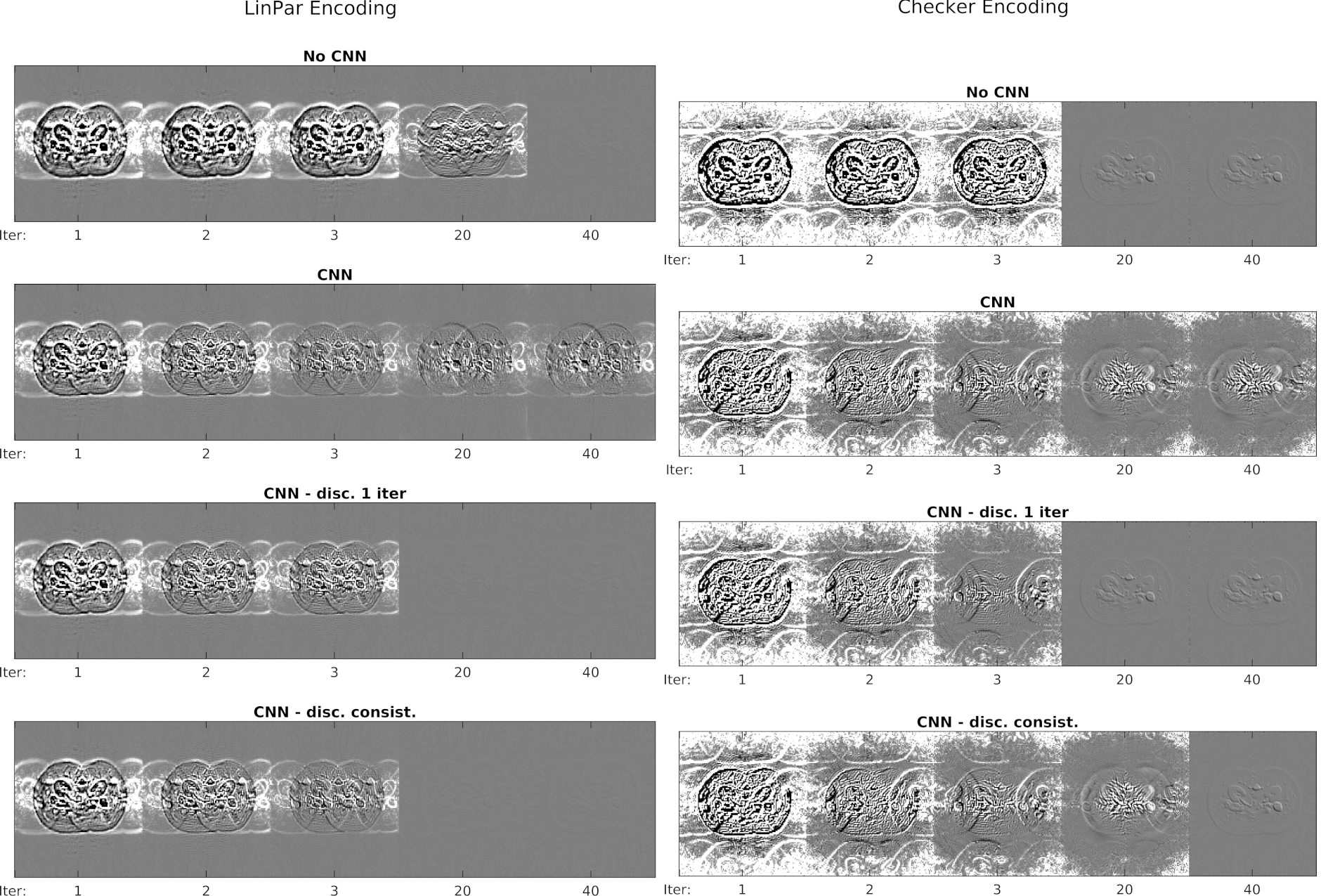
Figure 2 - Residuals from noiseless reconstructed images with different algorithms and sampling patterns.
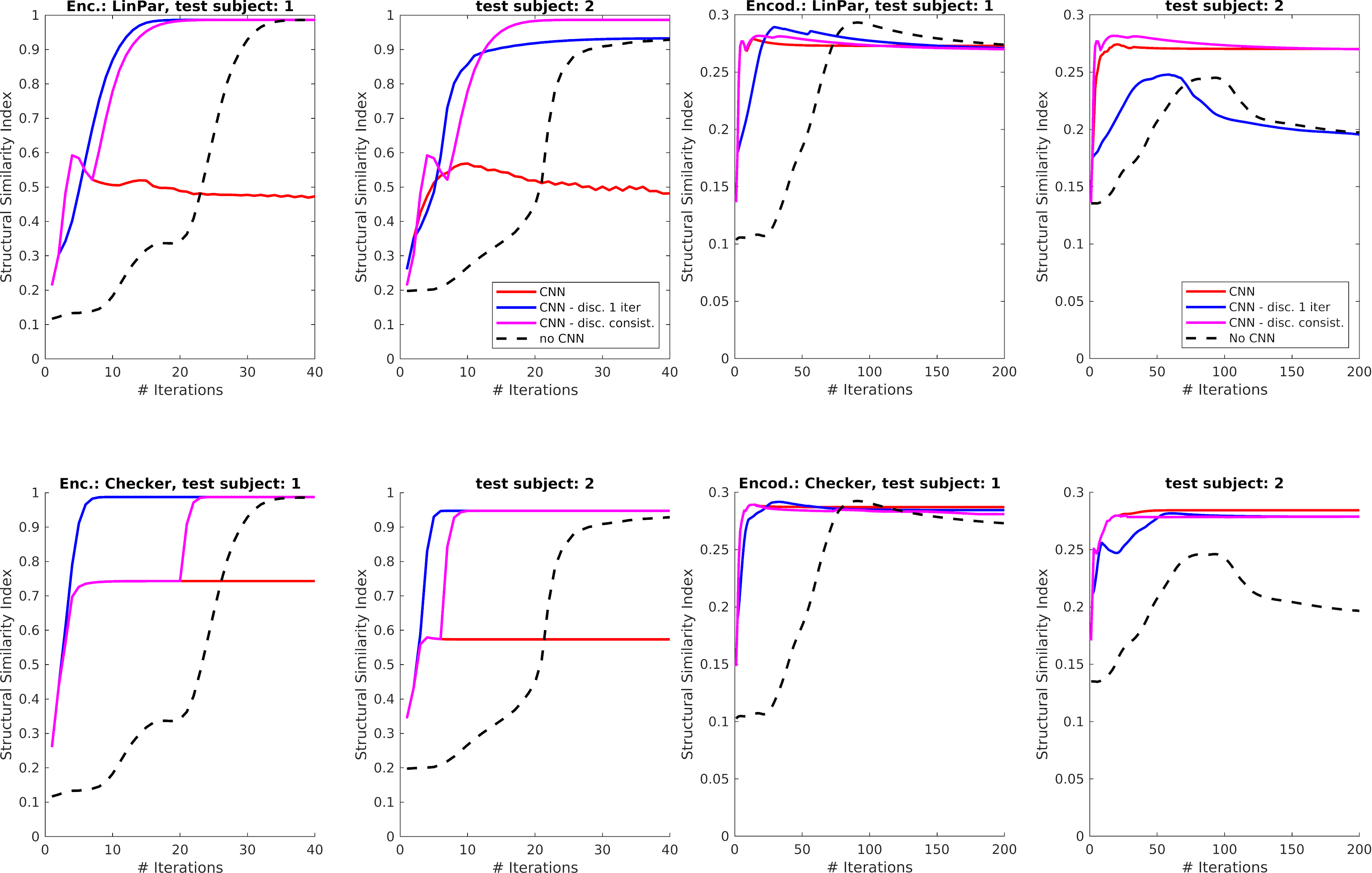
Figure 5 - Quality of the reconstructed images evaluated using the Structural Similarity Index (SSI) compared to the Ground Truth (GT) for noiseless (two columns on the left, corresponding to two test subjects) and noisy reconstructions (two columns on the right, same test subjects). The two rows correspond to different sampling schemes: LinPar (top) and Checkers (bottom). The CNN requires less iterations compared to the non-CNN case. When disconnecting the CNN with either approach, large improvements are seen in the absence of noise. These are more subtle when noise is present.