Tony Zhou1,2, Justin YC Lau1,2, Jack JJJ Miller1,2,3, Navjeet Chhina4, Christopher Randell4, and Damian J Tyler1,2
1Department of Physiology, Anatomy and Genetics, University of Oxford, Oxford, United Kingdom, 2Oxford Centre for Clinical Magnetic Resonance Research, University of Oxford, Oxford, United Kingdom, 3Department of Physics, University of Oxford, Oxford, United Kingdom, 4PulseTeq LTD, Chobham, United Kingdom
1Department of Physiology, Anatomy and Genetics, University of Oxford, Oxford, United Kingdom, 2Oxford Centre for Clinical Magnetic Resonance Research, University of Oxford, Oxford, United Kingdom, 3Department of Physics, University of Oxford, Oxford, United Kingdom, 4PulseTeq LTD, Chobham, United Kingdom
On transmit, a Multilayer RF coil offer improved B1+ efficiency and improved B1+ homogeneity over traditional surface loop coil designs. On receive, the Multilayer design may offer increased SNR over loop coils of a smaller effective radius.
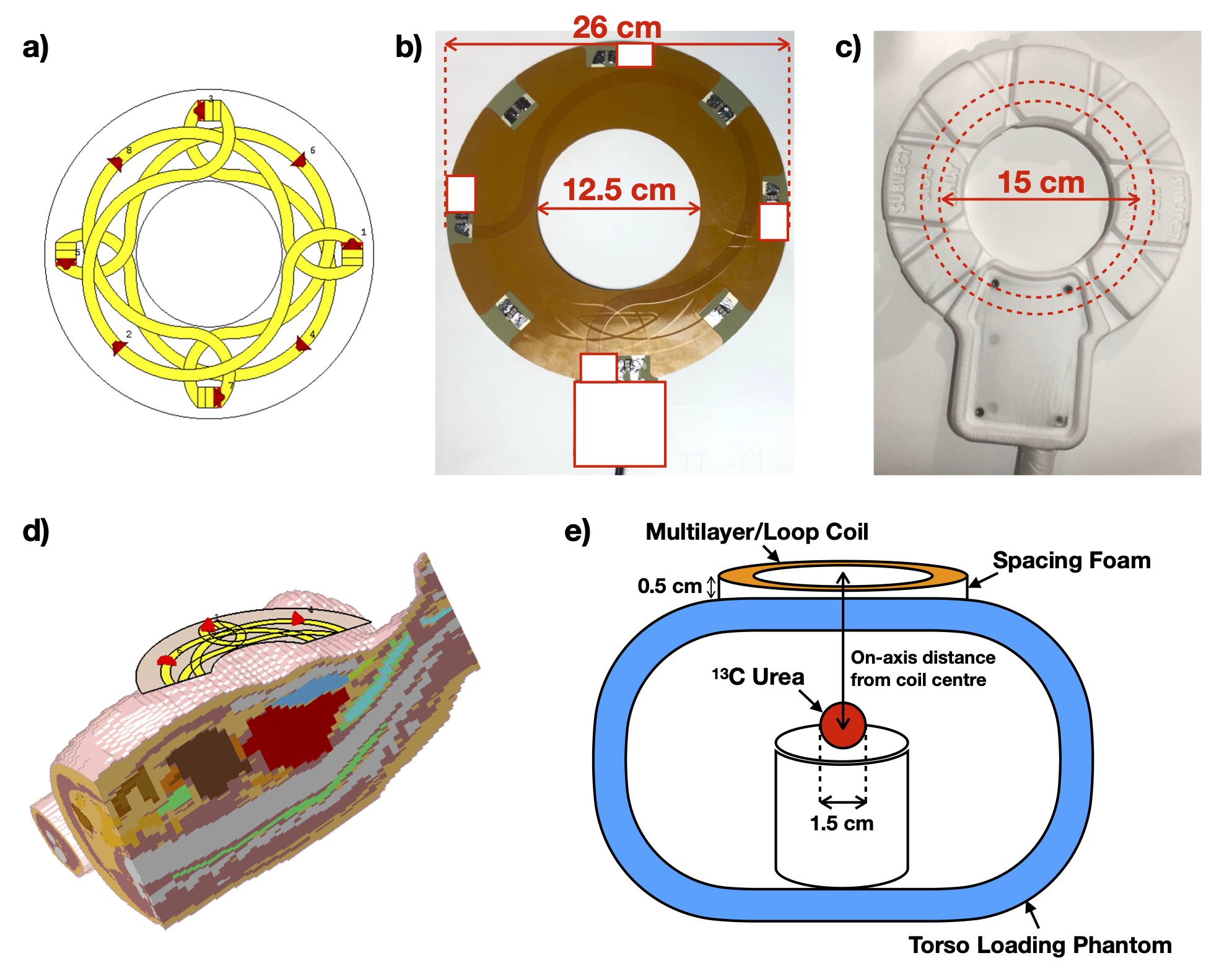
Figure 2: Experimental and simulated setup. (a) EM simulation model showing overlapping copper tracks for multilayer coil. (b) Photo of multilayer coil PCB showing use of capacitors to bridge between neighbouring layers. (c) Photo of 15cm diameter loop coil PCB. (d) EM simulation setup of coil position on a human voxel model over the heart. (e) Experimental setup of coil positioned on torso loading phantom with [13C]urea fiducial placed on axis.
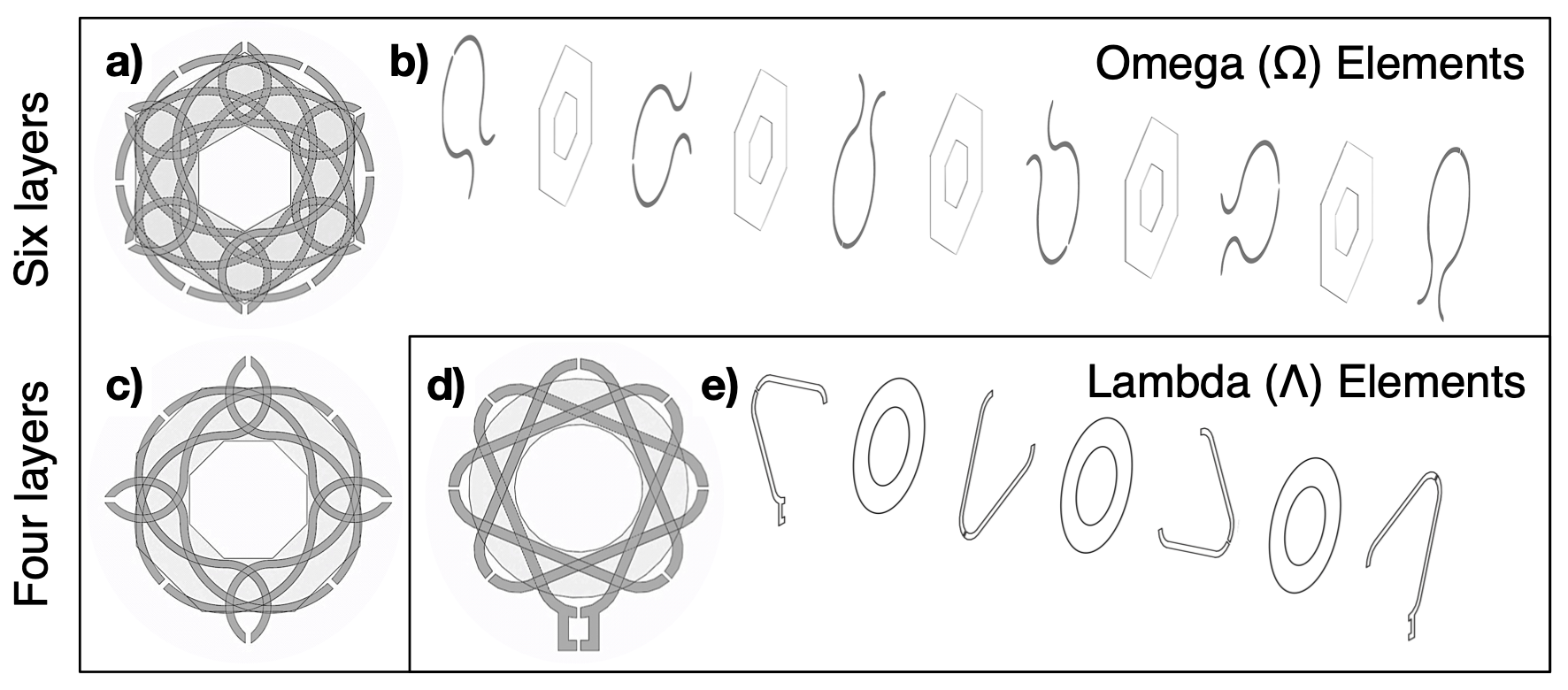
Figure 1: Example of Multilayer coil designs. (a) Top view of a six-layer ‘petal’ coil with omega elements. (b) Exploded view of a six-layer ‘petal’ coil showing alternating omega and dielectric elements. (c) Top view of a four-layer ‘petal’ coil with omega elements. (d) Top view of a four-layer ‘star’ coil with lambda elements. (e) Exploded view of a four layer ‘star’ coil showing alternating lambda and dielectric elements.