Roberta Frass-Kriegl1, Sajad Hosseinnezhadian2, Marie Poirier-Quinot2, Elmar Laistler1, and Jean-Christophe Ginefri2
1Division MR Physics, Center for Medical Physics and Biomedical Engineering, Medical University of Vienna, Vienna, Austria, 2IR4M (Imagerie par Résonance Magnétique et Multi-Modalités), UMR 8081, Université Paris-Sud/CNRS, Université Paris-Saclay, Orsay, France
1Division MR Physics, Center for Medical Physics and Biomedical Engineering, Medical University of Vienna, Vienna, Austria, 2IR4M (Imagerie par Résonance Magnétique et Multi-Modalités), UMR 8081, Université Paris-Sud/CNRS, Université Paris-Saclay, Orsay, France
Simulations
and experiments at 3T and 7T demonstrate that multi-loop coils, i.e. coils made
of small loops in series, provide a significant transmit efficiency boost over
conventional loop coils at close distance in sample-noise dominated settings.
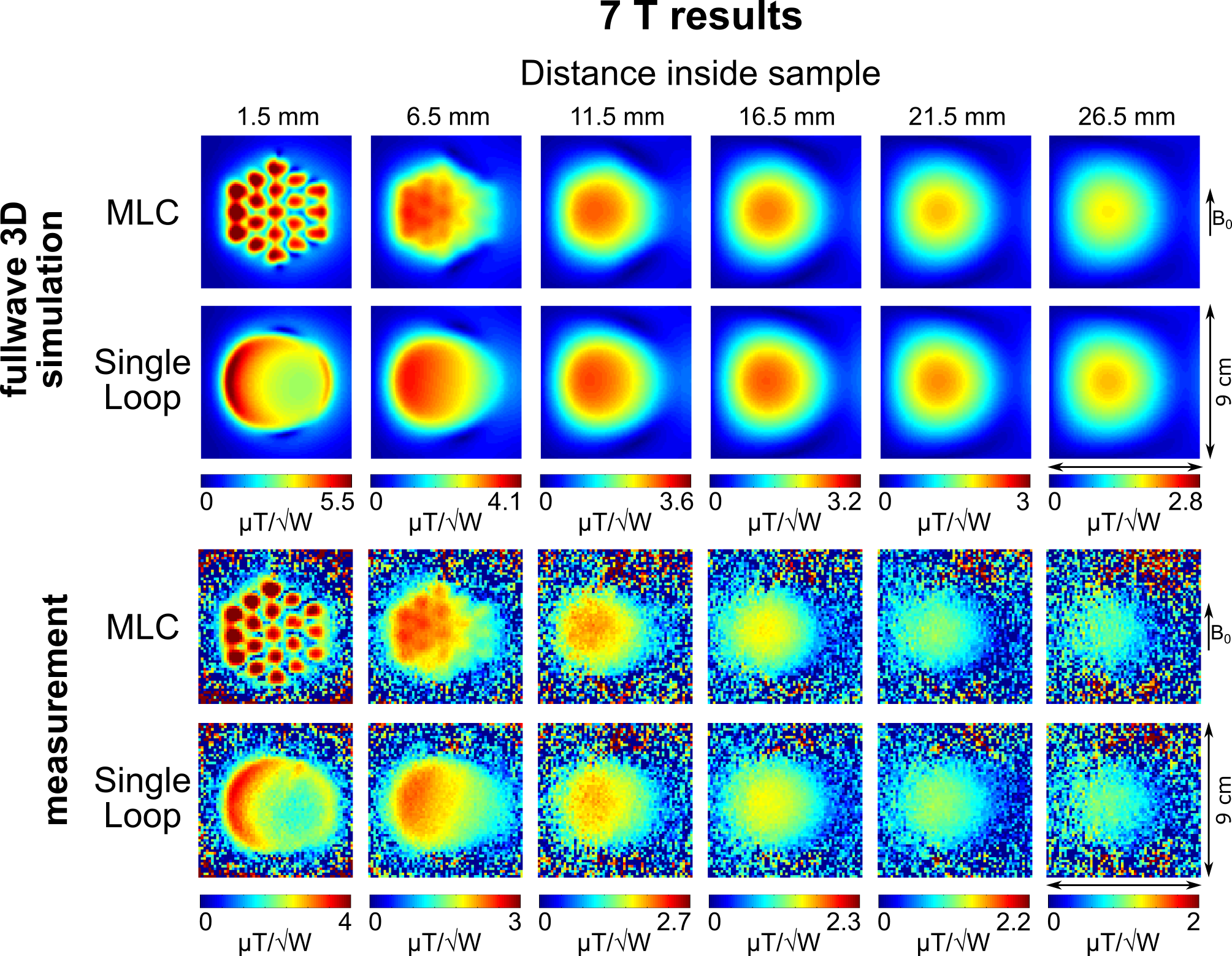
Figure 4. Maps
of the simulated and measured transmit efficiency at different depths inside
the sample for 7T coils. Note that the dimensions of the maps are different
from 3T images due to the smaller coil size. Sequence parameters for the flip
angle mapping sequence at 7T: TR = 6.93 s, TE = 2.66 ms, 128 x 128 acquisition
matrix, 1.5 mm x 1.5 mm in-plane pixel size, 4 averages.
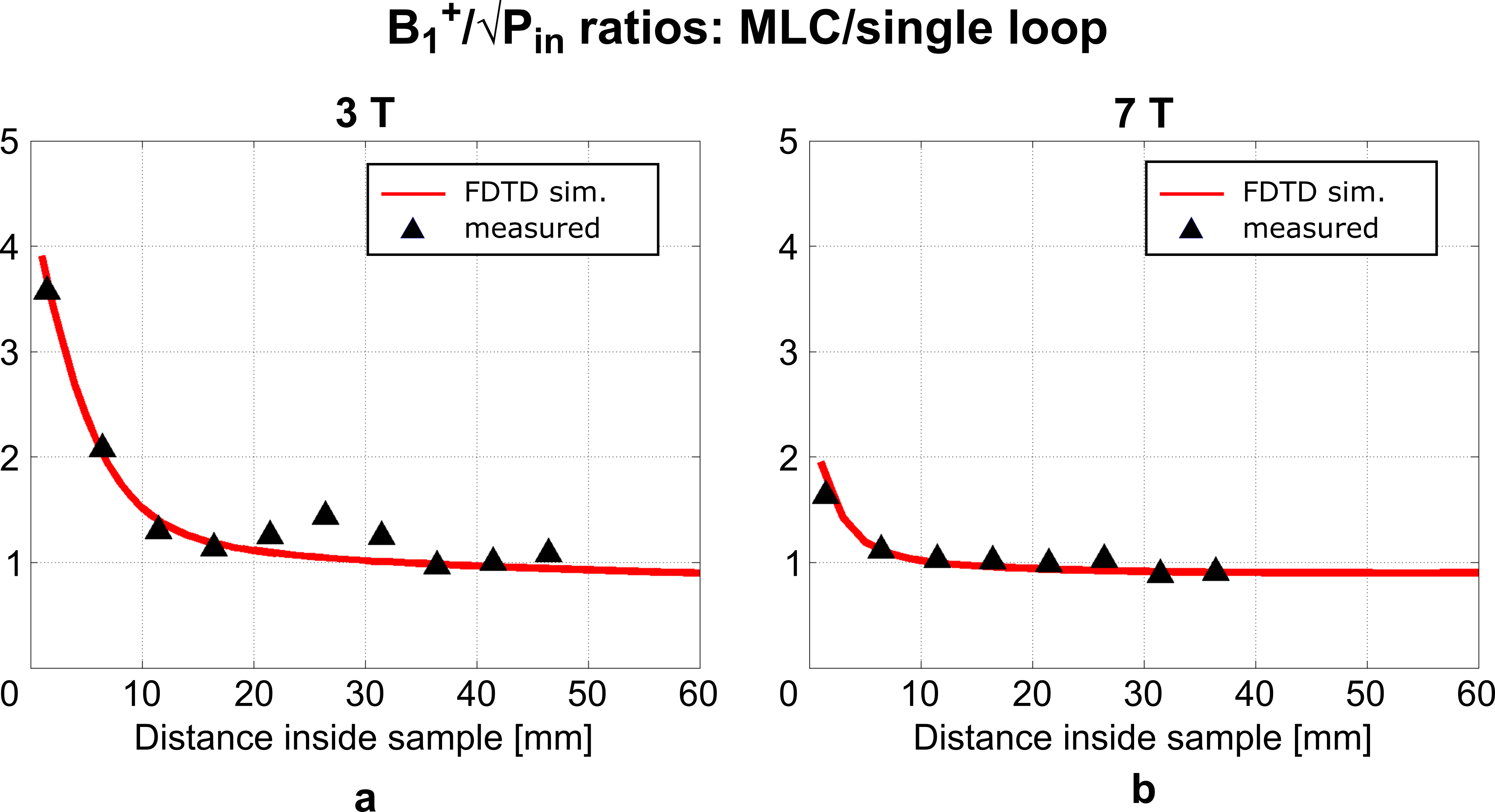
Figure 5. Transmit
efficiency ratios between MLCs and SLCs along the central coil axis for 3T (a)
and 7T (b). For experimental data, B1+ values in each
slice were averaged over 10 x 10 and 5 x 5 pixel ROIs centered on the coil
axis, for 3T and 7T, respectively, to limit the influence of measurement noise.