Antonella Castellano1, Alice Segato2, Valentina Pieri1, Marco Vidotto2, Nicolò Pecco1, Marco Riva3,4, Riccardo Secoli5, Davide Danilo Zani6, Stefano Brizzola6, Marco Trovatelli7, Giuliano Ravasio6, Marcello Cadioli8, Lorenzo Bello4,9, Ferdinando Rodriguez Y Baena5, Elena De Momi2, and Andrea Falini1
1Neuroradiology Unit and CERMAC, Vita-Salute San Raffaele University, IRCCS San Raffaele Scientific Institute, Milan, Italy, 2Department of Electronics, Information and Bioengineering, Politecnico di Milano, Milan, Italy, 3Department of Medical Biotechnology and Translational Medicine, Università degli Studi di Milano, Milan, Italy, 4Neurosurgical Oncology Unit, IRCCS Humanitas Clinical and Research Center, Rozzano (MI), Italy, 5Department of Mechanical Engineering, Imperial College London, London, United Kingdom, 6Department of Veterinary Medicine, Università degli Studi di Milano, Milan, Italy, 7Department of Health, Animal Science and Food Safety, Faculty of Veterinary Medicine, Università degli Studi di Milano, Milan, Italy, 8Philips Healthcare, Milan, Italy, 9Department of Oncology and Hemato-Oncology, Università degli Studi di Milano, Milan, Italy
1Neuroradiology Unit and CERMAC, Vita-Salute San Raffaele University, IRCCS San Raffaele Scientific Institute, Milan, Italy, 2Department of Electronics, Information and Bioengineering, Politecnico di Milano, Milan, Italy, 3Department of Medical Biotechnology and Translational Medicine, Università degli Studi di Milano, Milan, Italy, 4Neurosurgical Oncology Unit, IRCCS Humanitas Clinical and Research Center, Rozzano (MI), Italy, 5Department of Mechanical Engineering, Imperial College London, London, United Kingdom, 6Department of Veterinary Medicine, Università degli Studi di Milano, Milan, Italy, 7Department of Health, Animal Science and Food Safety, Faculty of Veterinary Medicine, Università degli Studi di Milano, Milan, Italy, 8Philips Healthcare, Milan, Italy, 9Department of Oncology and Hemato-Oncology, Università degli Studi di Milano, Milan, Italy
Microstructural tissue properties depicted by DTI can impact the in vivo distribution of therapeutics delivered by Convection-Enhanced Delivery within the brain.
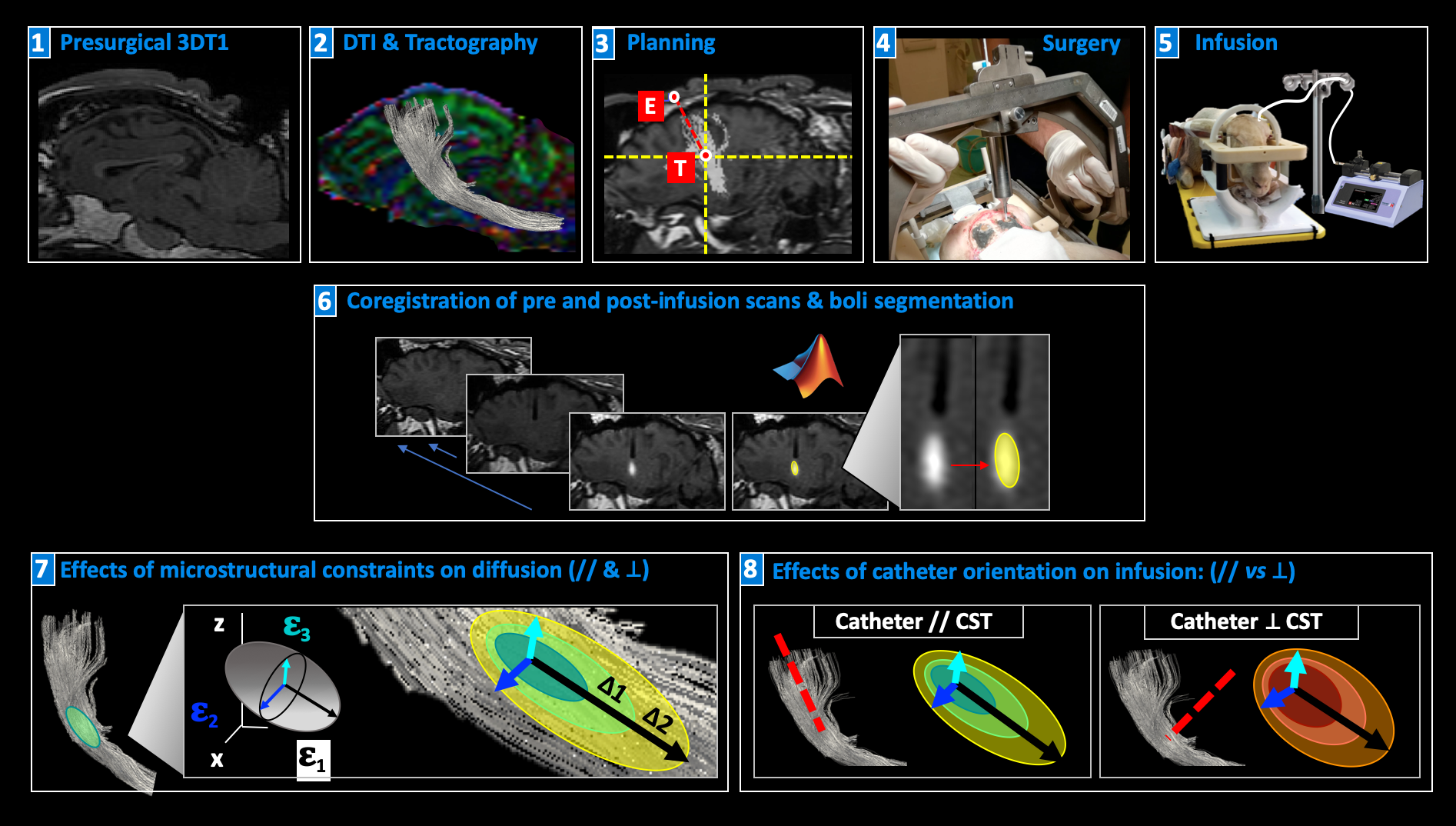
Summary of the whole experimental procedure and of the quantitative MRI and DTI analyses. E: entry point of the catheter; T: target point. See text for details.
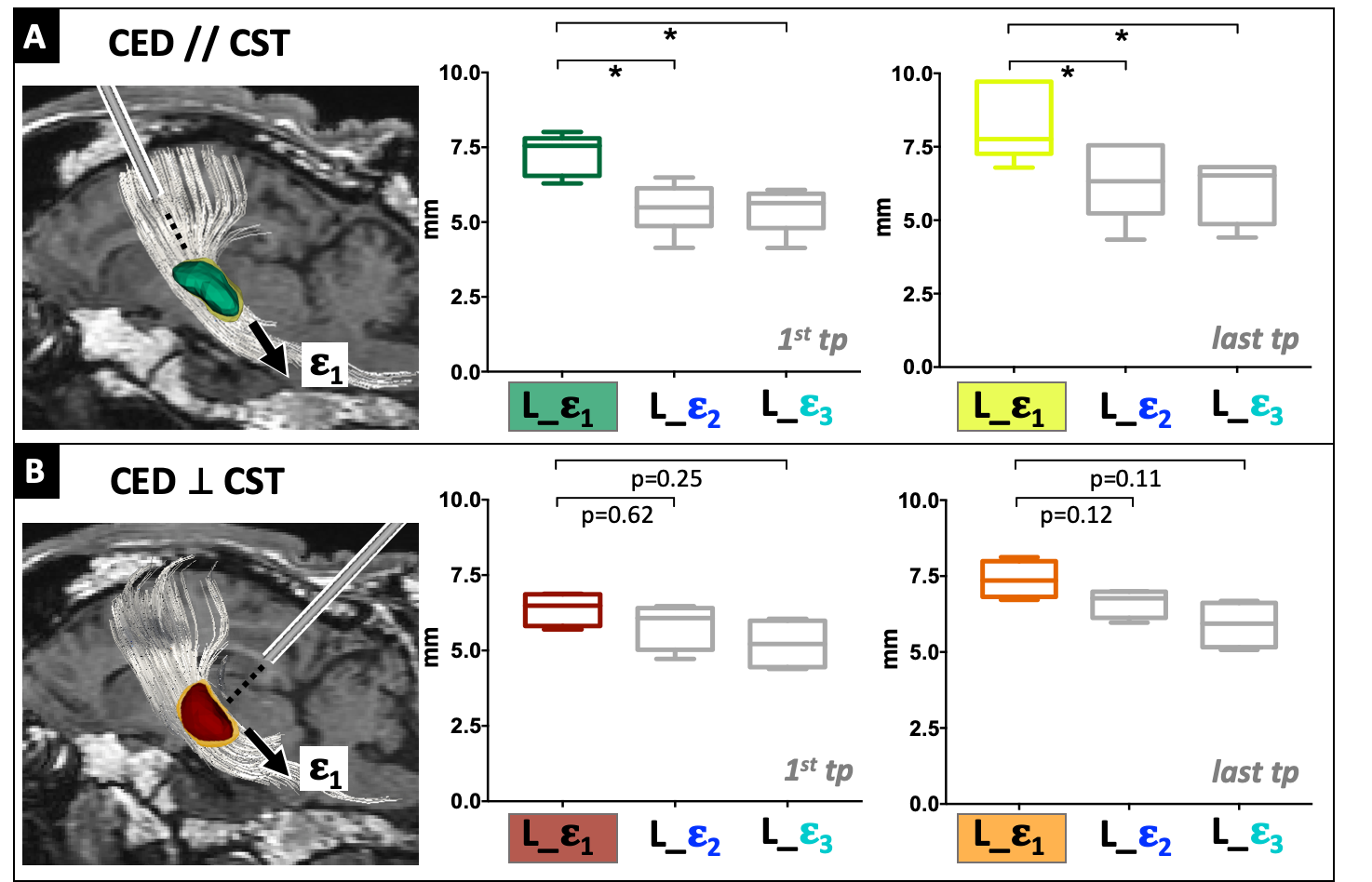
Absolute lengths (L) of the boli at the 1st and last timepoints (tp) along DTI ε1, ε2, ε3. (A) Infusions parallel to CST fibers demonstrate an absolute L of boli along ε1 significantly greater than L along ε2 and ε3 already at the 1st tp, maintaining this difference over time. (B) Infusions orthogonal to fibers show a non-significant trend of a greater L along ε1, that becomes more pronounced over time. (*P ≤ 0.05)