Dan Wu1, Dapeng Liu2, Yi-Cheng Hsu3, Haotian Li1, Yi Sun3, Qin Qin2, and Yi Zhang1
1Key Laboratory for Biomedical Engineering of Ministry of Education, Department of Biomedical Engineering, College of Biomedical Engineering & Instrument Science, Zhejiang University, Hangzhou, China, 2Johns Hopkins University School of Medicine, BALTIMORE, MD, United States, 3MR Collaboration, Siemens Healthcare Ltd., Shanghai, China
1Key Laboratory for Biomedical Engineering of Ministry of Education, Department of Biomedical Engineering, College of Biomedical Engineering & Instrument Science, Zhejiang University, Hangzhou, China, 2Johns Hopkins University School of Medicine, BALTIMORE, MD, United States, 3MR Collaboration, Siemens Healthcare Ltd., Shanghai, China
We propose a 3D oscillating gradient prepared
gradient spin-echo sequence (OGprep-GRASE), which reduced the scan time by a
factor of 1.38 and increased the SNR by 1.74 times, compared with the conventional
2D EPI dMRI, leading to improved diffusion tensor reconstruction.
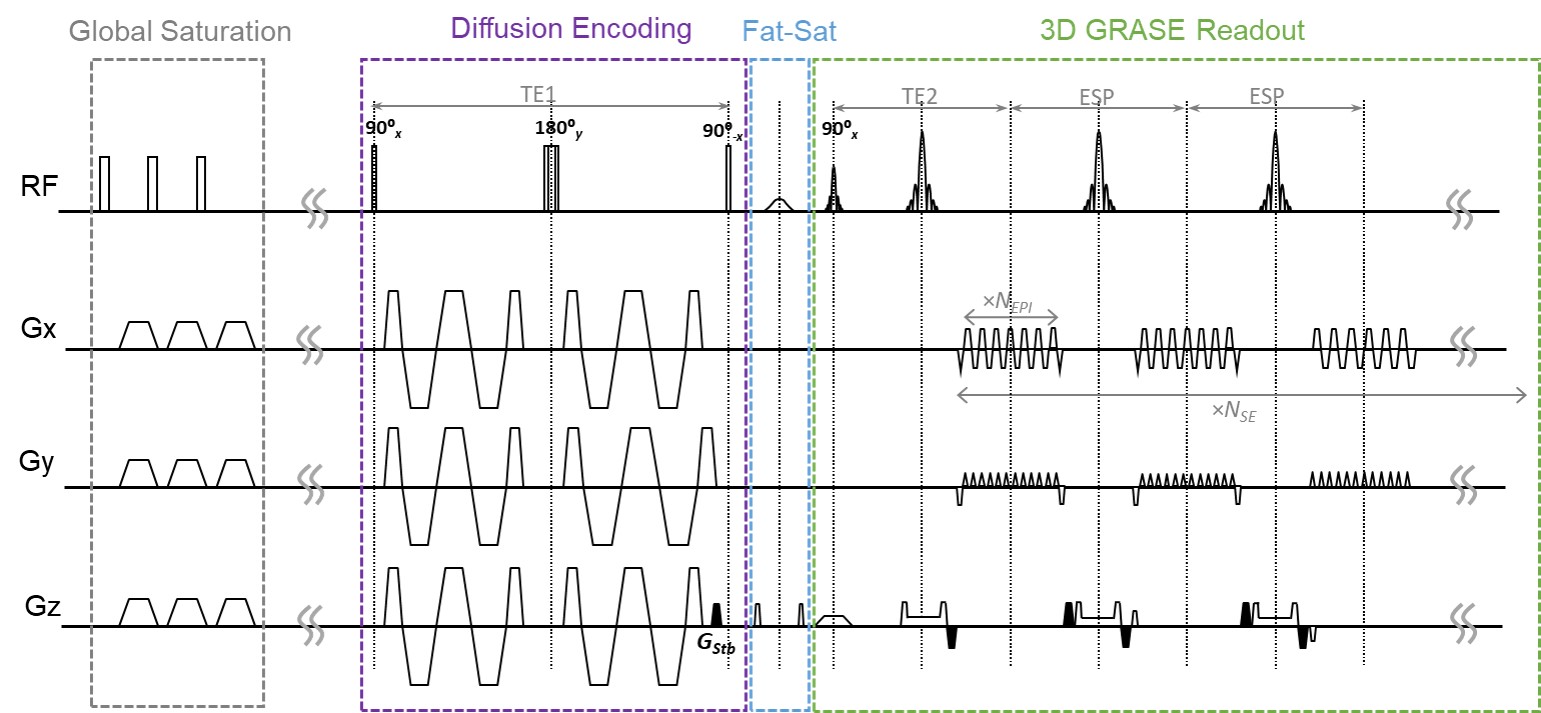
Figure 1.
Diagram of the 3D OGprep-GRASE sequence, which contains a global saturation
module, a diffusion preparation module, a fat saturation module, and a 3D GRASE
module.
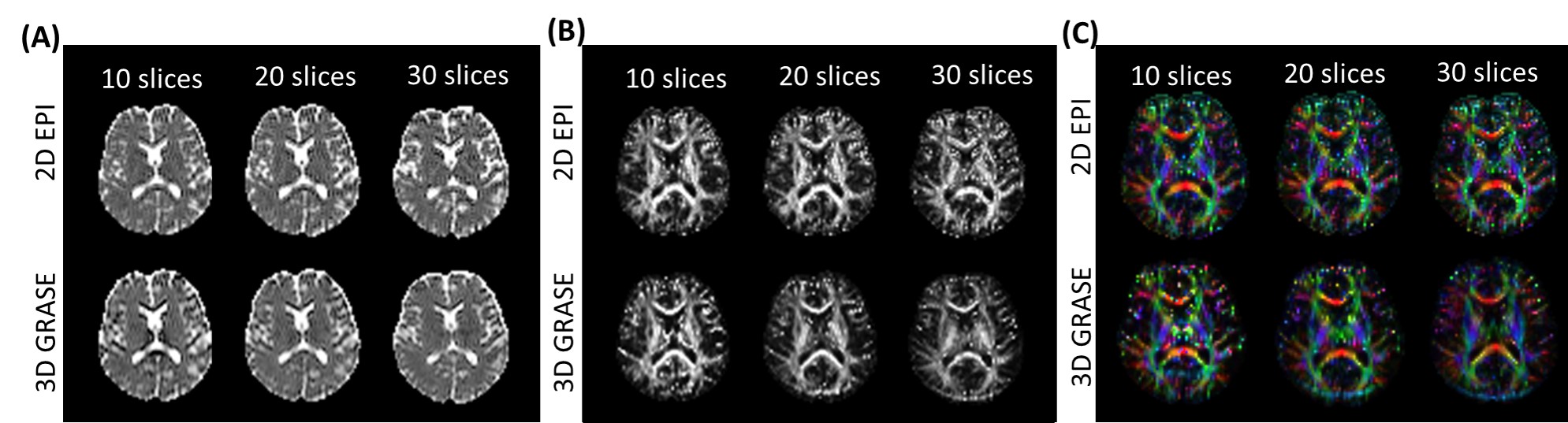
Figure 3. Apparent diffusion coefficient (ADC) maps (A), fraction anisotropy (FA) maps (B),
and (C) direction-encoded colormaps (DEC) (C) reconstructed from OG-dMRI data using
2D EPI or 3D GRASE sequences. The improvement of image quality by 3D GRASE is evident from the less noisy ADC and FA maps and cleaner DEC maps. The improvement was more
pronounced as the number of slices (imaging volume) increased.