Cornelius Eichner1, Michael Paquette1, Angela D Friederici1, and Alfred Anwander1
1Department of Neuropsychology, Max Planck Institute for Human Cognitive and Brain Sciences, Leipzig, Germany
1Department of Neuropsychology, Max Planck Institute for Human Cognitive and Brain Sciences, Leipzig, Germany
Informed MP-PCA significantly improves the denoising-performance on advanced dMRI data with high resolutions and strong diffusion-weighting. Specifically, iMP-PCA reduces global noise levels while retaining local tissue-related signal differences.
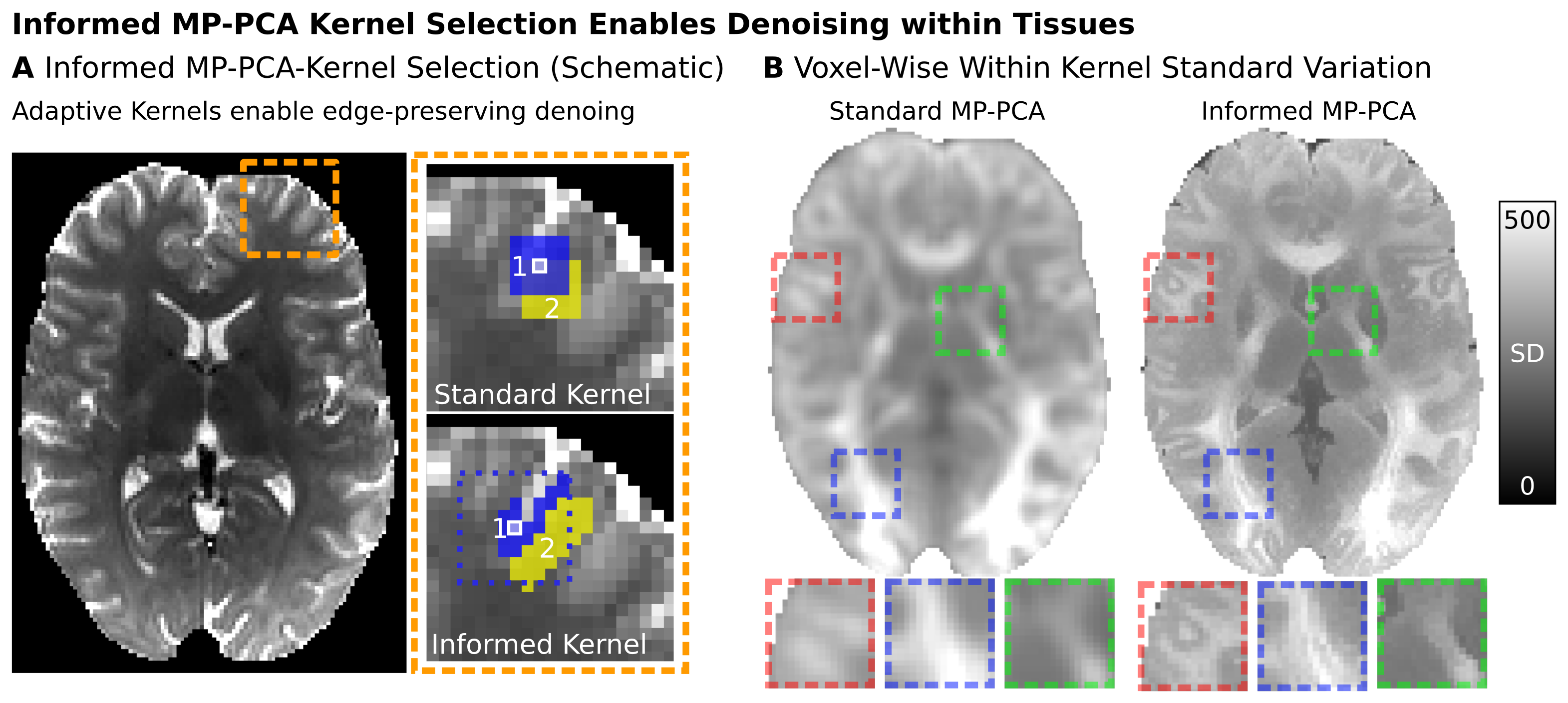
Figure 3: A The iMP-PCA kernel is defined by similarity of voxels within a larger region (dotted blue). Best matching voxels are selected for denoising. Every voxel potentially has its own kernel shape, depending on the underlying tissue. B The voxel-wise intra-kernel standard variation (SD) shows tissue-preserving characteristics of iMP-PCA. Informed adaptive kernels result in separation of tissue types in cortex and specific white matter tracts (see enlargements).
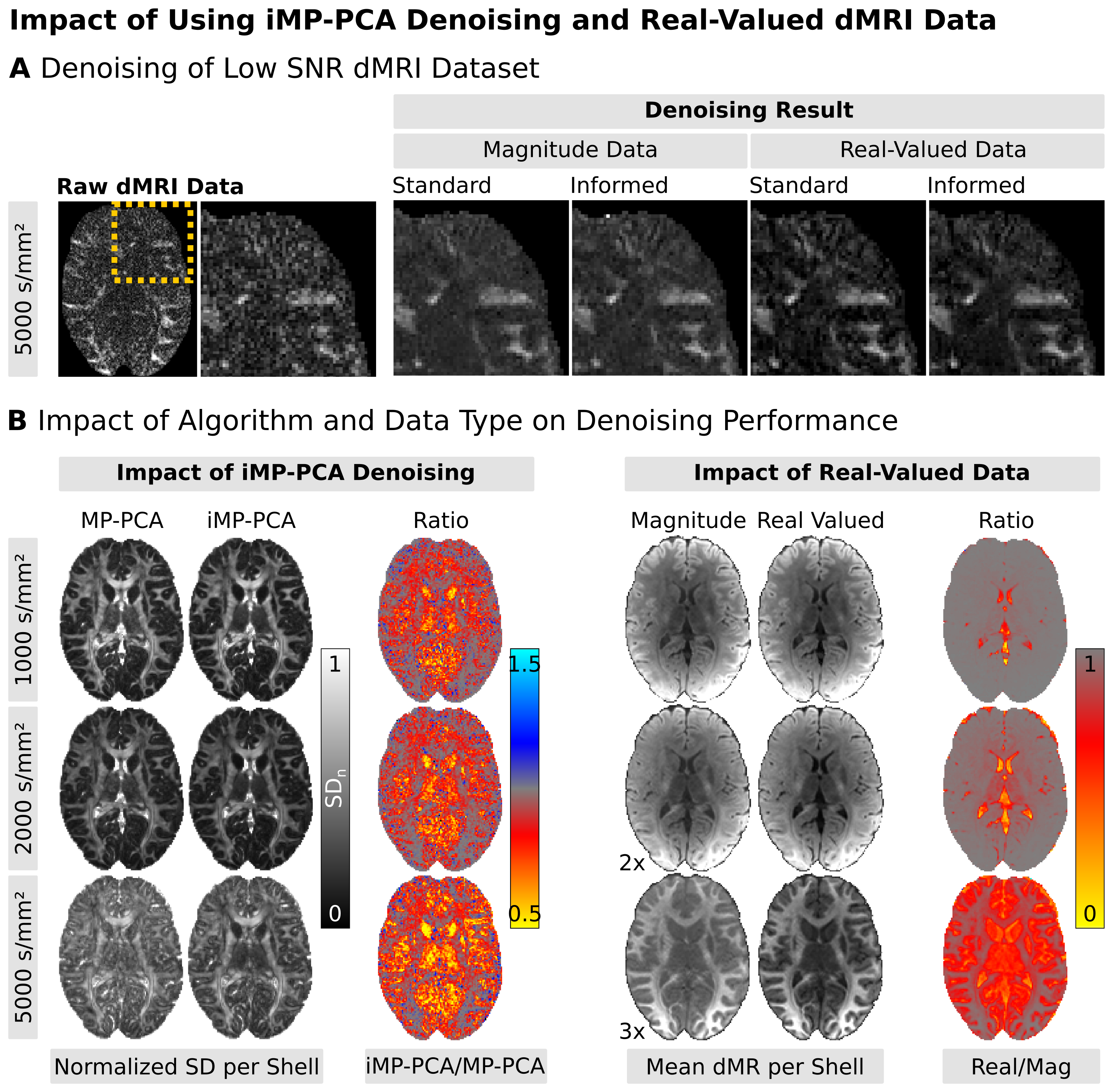
Figure 4: A iMP-PCA denoising with real-valued dMRI data is superior with improved signal-attenuation and reduced noise B Left: iMP-PCA denoising retains tissue-related, large signal-variations in highly anisotropic white matter regions - however, it reduces noise in less anisotropic regions, such as in gray matter for all b-shells (ratio). Right: Real-valued dMRI denoising impact becomes evident at b=2000 with a stronger noise attenuation in central grey matter regions (ratio).