Elizabeth Powell1,2, Torben Schneider3, Marco Battiston2, Francesco Grussu2,4, Ahmed Toosy2, Jonathan D Clayden5, and Claudia A. M. Gandini Wheeler-Kingshott2,6,7
1Medical Physics and Biomedical Engineering, University College London, London, United Kingdom, 2NMR Research Unit, Queen Square MS Centre, Department of Neuroinflammation, UCL Queen Square Institute of Neurology, Faculty of Brain Sciences, University College London, London, United Kingdom, 3Philips Healthcare, Guildford, United Kingdom, 4Centre for Medical Image Computing, Department of Computer Science, University College London, London, United Kingdom, 5Developmental Imaging and Biophysics Section, Great Ormond Street Institute of Child Health, University College London, London, United Kingdom, 6Department of Brain and Behavioural Sciences, University of Pavia, Pavia, Italy, 7Brain MRI 3T Center, IRCCS Mondino Foundation, Pavia, Italy
1Medical Physics and Biomedical Engineering, University College London, London, United Kingdom, 2NMR Research Unit, Queen Square MS Centre, Department of Neuroinflammation, UCL Queen Square Institute of Neurology, Faculty of Brain Sciences, University College London, London, United Kingdom, 3Philips Healthcare, Guildford, United Kingdom, 4Centre for Medical Image Computing, Department of Computer Science, University College London, London, United Kingdom, 5Developmental Imaging and Biophysics Section, Great Ormond Street Institute of Child Health, University College London, London, United Kingdom, 6Department of Brain and Behavioural Sciences, University of Pavia, Pavia, Italy, 7Brain MRI 3T Center, IRCCS Mondino Foundation, Pavia, Italy
SENSE reconstruction with 2D phase correction and channel-wise noise removal (SPECTRE) is proposed to simultaneously provide robust Nyquist ghost correction and alleviate associated noise amplification in order to avoid ghosting- and noise-related biases in diffusion parameter maps.
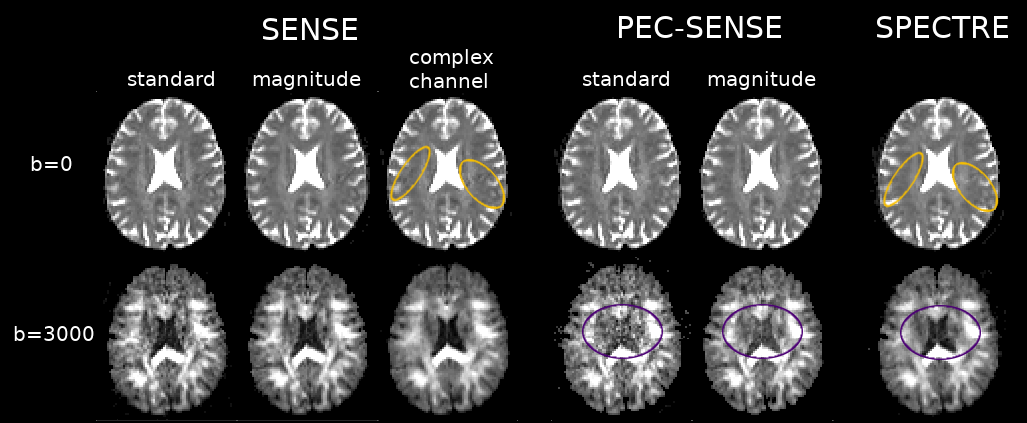
Fig. 2. Ghosting artefacts were visible in the SENSE reconstructions (left, yellow outline), while noise amplification was present at high b-values in the standard and magnitude PEC-SENSE reconstructions (middle, purple outline). Denoising complex channel data during a 2D phase-corrected reconstruction both mitigated ghosting artefacts (right, yellow outline) and limited noise propagation (right, purple outline). Note the noise-floor was also significantly reduced in complex channel denoised data (CSF in purple outlined region, right).
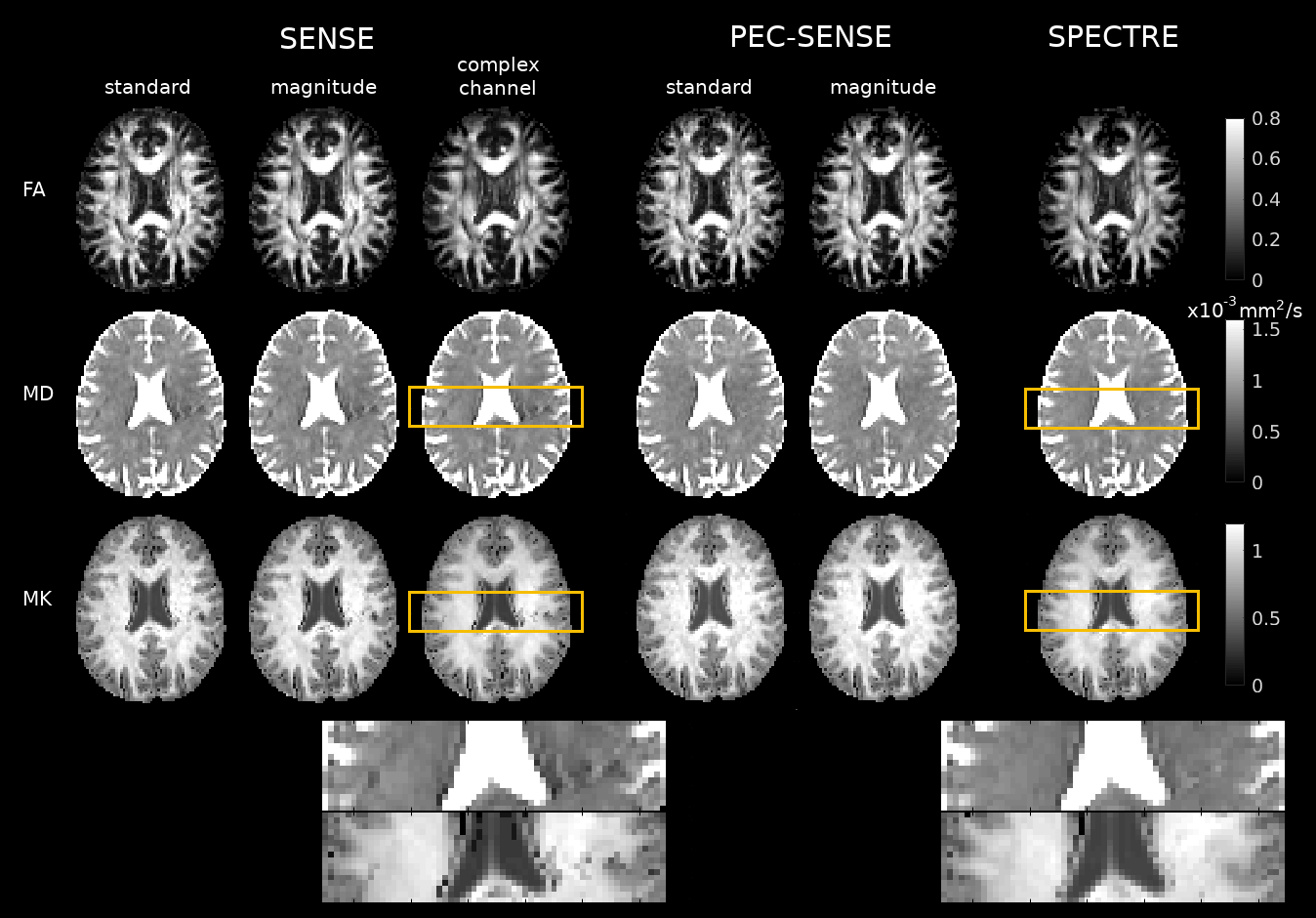
Fig. 3. Residual ghosting in SENSE reconstructions introduced appreciable local biases into MD and MK maps (left, yellow zoomed regions). Phase correction in PEC-SENSE removed biases from ghosting (right, yellow zoomed regions); however, MK estimates in standard and magnitude denoised PEC-SENSE reconstructions appeared inflated on visual inspection. These noise-related biases in MK were less apparent in SPECTRE.