HyukJin Yun1, Lana Vasung1, Tomo Tarui2, Caitlin K. Rollins3, Cynthia M. Ortinau4, P. Ellen Grant1, and Kiho Im1
1Newborn Medicine, Boston Children's Hospital, Boston, MA, United States, 2Pediatric Neurology, Tufts Medical Center, Boston, MA, United States, 3Neurology, Boston Children's Hospital, Boston, MA, United States, 4Pediatrics, Washington University in St. Louis, St. Louis, MO, United States
1Newborn Medicine, Boston Children's Hospital, Boston, MA, United States, 2Pediatric Neurology, Tufts Medical Center, Boston, MA, United States, 3Neurology, Boston Children's Hospital, Boston, MA, United States, 4Pediatrics, Washington University in St. Louis, St. Louis, MO, United States
Sulcal
pits in the fetal brain showed temporally uniform distribution and regionally
different timing of emergence against dynamic folding changes during the second
half of gestation. It demonstrated sulcal pits are important landmarks of human
brain development in early fetal stage.
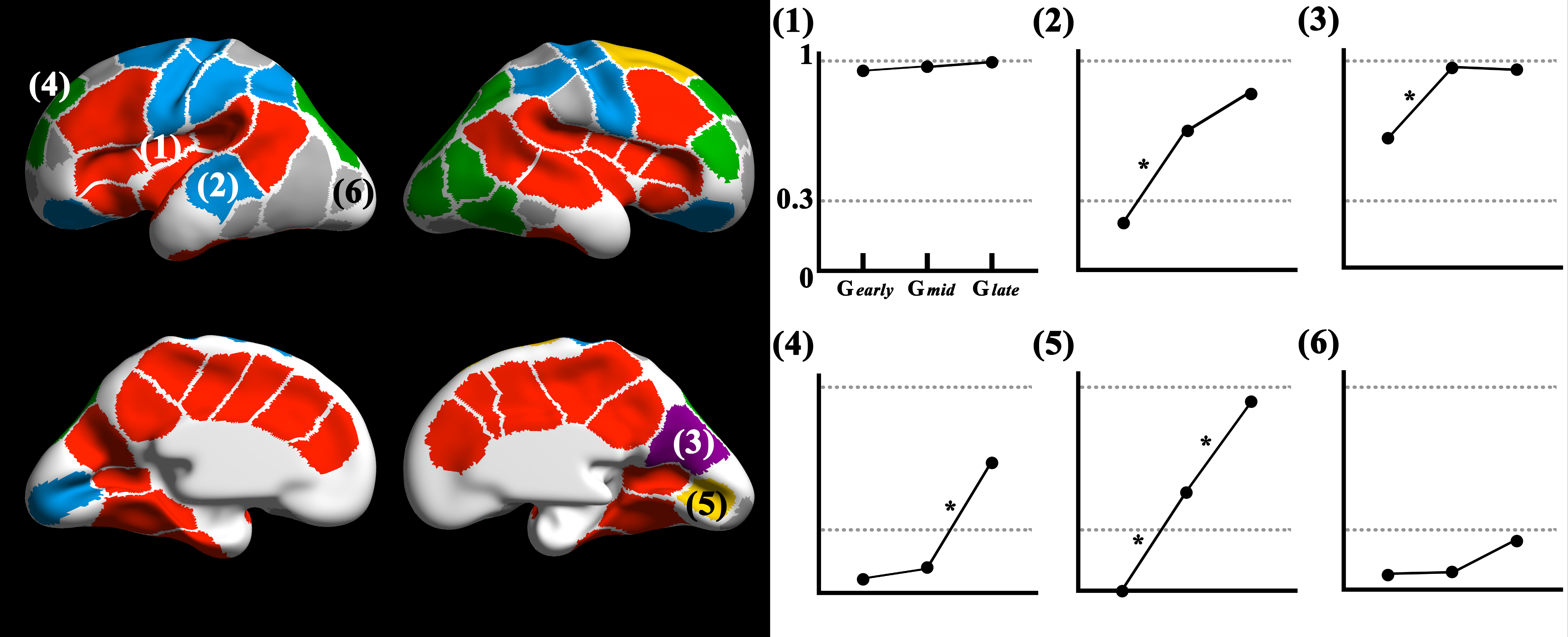
Cluster-wise
results of pit emergence. The colors in the clusters on the surface (left)
indicating changes of pit presence among fetal subgroups, and examples of
changes of frequency in six clusters are provided (right). Colors of the
clusters represent the statistics of frequency change. *: significant change of
pit presence (FDR corrected p < 0.05) between two subgroups. (1) left
Sylvian fissure c, (2) left superior temporal b, (3) right parieto-occipital,
(4) left middle frontal a, (5) right calcarine b, and (6) left lateral
occipital sulcus.
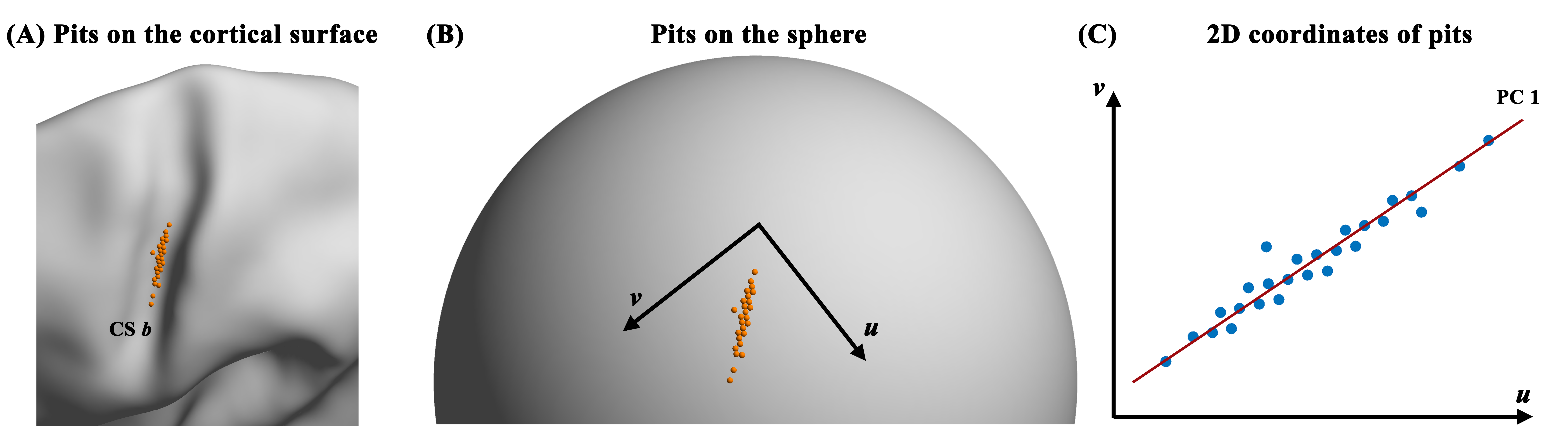
Dimension
reduction of coordinates of sulcal pits. (A) sulcal pits (orange spheres) in
the central sulcus b (CS b) are converted to (B) the sphere to reduce them to
2D spherical coordinates. (C) The spherical coordinates were projected to
tangential plane (blue circles) which have orthogonal coordinate system (u, v).
Principal component analysis is performed the 2D coordinates on tangent plane
and converted them to 1D coordinates along with the first principal component
(PC1, line).