 We are just a few months away from the meeting in Cape Town, 09-14 May 2026, and I am getting more excited by the day. At the meeting we will see our community’s Ubuntu spirit in action–the collaborative research and development across scientists, engineers, clinicians, and radiographers for positive impact in MRI. The meeting has some exciting changes this year including Study Group Sunday, Flash Presentations, Case-Based sessions, longer breaks between sessions, and (hopefully) improved digital posters. Please read on for details.
First, if you have any questions about Cape Town, please join our virtual meeting on 23 February 2026 at 17:30 UTC. You can register here. ISMRM President Mark Griswold and I will talk about our trip to Cape Town, and we’ll be joined by Ernesta Meintjes and others from the University of Cape Town. We hope to provide you with some information about travel to Cape Town and answer any questions you may have. There will be additional virtual meetings in March and April for new ISMRM attendees.
Study Group Sunday will kickstart our meeting this year. Attendance is included in the five-day registration. Throughout the day on Sunday, we will have longer Study Group sessions to build connections, and then we hope that these connections will continue to develop throughout the week. The Study Group leadership will prepare a “walk-through-the-week” to suggest sessions their members should consider attending. Additionally, there will be Study Group banners to help you find your community within the plenary and session halls. Please arrive in Cape Town in time to participate with your Study Group on Sunday. Everyone is welcome to join the Study Group Sunday sessions.
Our community loves the Power Pitch sessions, and we are space-limited in the number that we can offer at the meeting. So, in addition to the Power Pitch sessions, we will have Flash Presentations this year. A Flash Presentation is similar to a Power Pitch presentation in that it consists of a 2-minute Oral Pitch and a poster presentation for open discussion. The main difference is that the poster presentation is in the traditional format (paper poster). The Flash Presentations will take place on the second floor of the convention center in the Terrace Room, a space with natural light and a view of Table Mountain! The Terrace Room will accommodate both the oral presentations accompanied by slides and the poster session.
Part of the ISMRM Ubuntu spirit is the collaboration across technologists, scientists, radiologists, and other physicians. This year, we will offer Case-Based Sessions that simulate the reading room experience. Radiologists will offer small group teaching sessions at a workstation to explain how they assess images from the clinical perspective. Please stay tuned for more information about these sessions.
Finally, I know that you all have opinions about digital posters. Over the last few years, as I prepared to be AMPC chair, I have heard a wide range of opinions. Some of you would like to do away with digital posters entirely. Others absolutely love digital posters and prefer them to oral sessions. There will be digital posters again this year. In recent years, there have been challenges to the format. Licensing issues and cost prohibit making the posters in PowerPoint, which led us to adopt the video format. The video format resulted in buffering issues that were frustrating for everyone. This year, the ECHO platform gives us a new opportunity for digital posters.
Digital posters will retain a similar look as recent years, but they should be flexible to your needs and also be more responsive during your presentation. This year, you will create your digital poster in ECHO, and it will render as an html page for presentation. It will have the same frame that we’ve used in recent years with the title and poster number clearly visible at the top and sections along the left-hand side. These sections will allow you to link to the different parts of your poster. Additionally, we’ll initially populate these sections from your abstract submission. A few screenshots of the prototype are shown below.
Our annual meeting is a time for our community to gather, connect, and communicate our scientific advances. These changes to the meeting are geared towards these objectives. Thank you for joining us as we try these new approaches to the annual meeting. I appreciate your feedback, and I hope that you’ll see your input reflected when we are in Cape Town.
Katy Keenan, Ph.D.
2026 Annual Meeting Program Chair
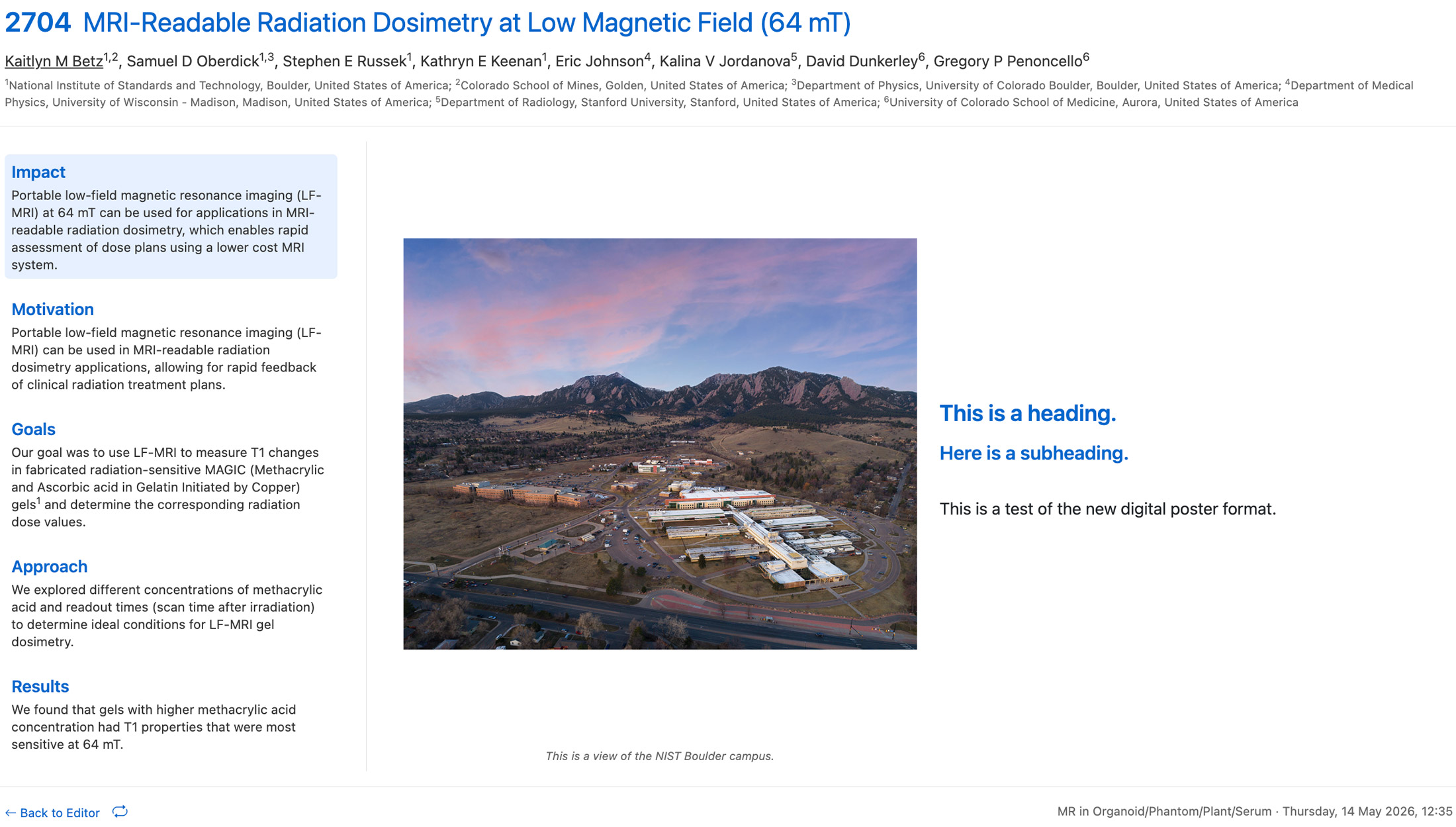
We have a new digital poster format this year, which is similar to recent years. However, the poster is now constructed within ECHO.
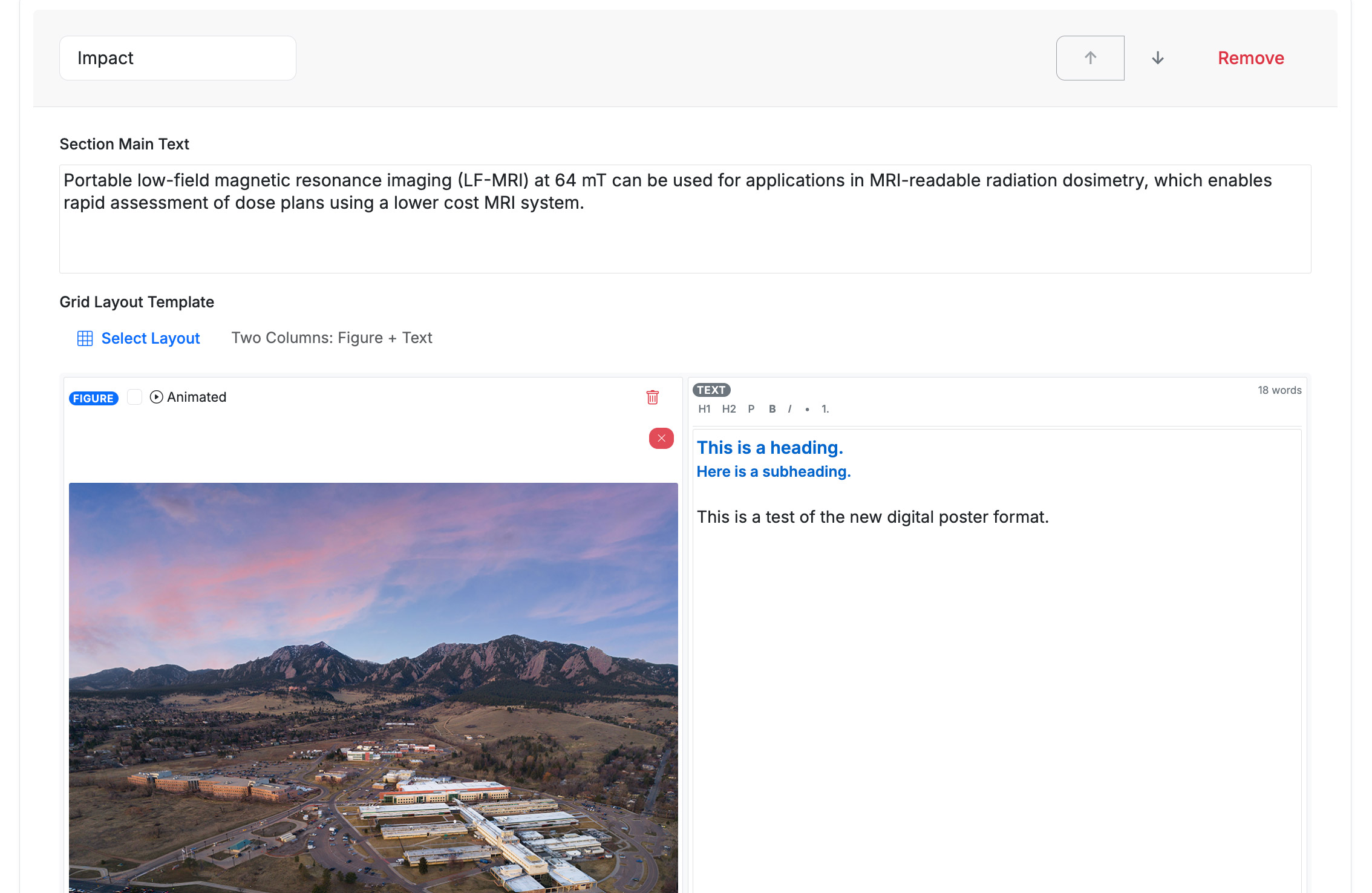
Within ECHO you can modify the text, images, and videos that are presented in each section.
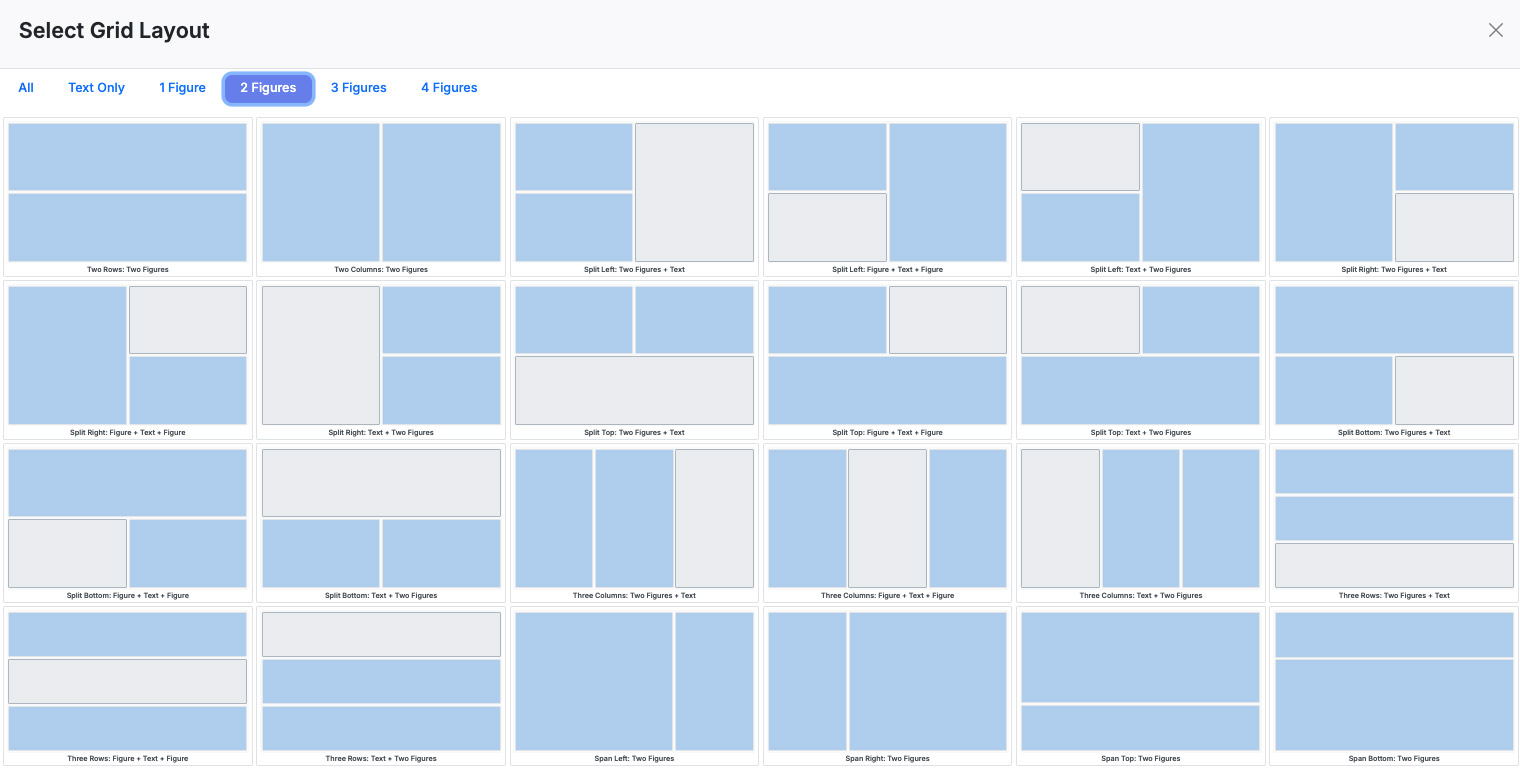
There are several different layout options so that you can customize the poster to your needs.