Dear Magnetic Resonance in Medicine Subscribers,
Firstly, I want to remind authors of Magn Reson Med‘s Code Review facility. This is a service kindly provided by (predominantly) members of the ISMRM Reproducible Research Study Group (RRSG). They will offer to download and check (for operability and documentation) code that is provided in a Data Availability Statement. They do not check the science (the scientific review of the paper is a separate process), but they often notice missing files, libraries or user instructions that make the code more robust for community use. There used to be a checkbox in Manuscript Central for authors to tick if they wished the RRSG to perform a Code Review. Unfortunately, within the new Wiley ReX Submission site there is no ability to add such a custom checkbox, and requests for Code Reviews have coincidentally decreased. Therefore, I remind you to please indicate in your cover letter if you wish to have your code undergo a Code Review. It is clearly a valuable service and I would encourage you to opt in to this service when submitting your paper. For FAQs on Code Reviews please see here.
Also, I wish to announce that we are imminently due to roll out a new category of paper. This is the “Toolbox Article”, that is a category that can be used for high-quality papers that describe an important tool (often a software tool) that has high value to the wider scientific community. It would generally be expected that such papers include a Data Availability Statement that makes the tool freely available, and that the authors agree to undergo a Code Review (for software tool articles). Also, it will be expected that the tool should be maintained for a sufficient period of time (at least 5 years and ideally at least 10 years), and that wording is included in the Data Availability Statement describing how the tool will be supported by the authors and for how long. Please look out for this new category of paper, which we feel will be more suitable for such papers, rather than them being submitted in either the “Research Article” category or the “Technical Note” category.
Finally, I hope you receive good news on your ISMRM abstract submissions, and don’t forget to start planning your travel, accommodation and registration for the 2026 ISMRM Annual Meeting in Cape Town.
Best wishes,
Peter Jezzard, PhD
HEADLINES
- Don’t forget to keep checking Study Group Virtual Special Issues that can be found at the journal homepage. Most ISMRM Study Groups have created Virtual Special Issues, with the aim of summarising the latest research in these topic areas. The idea is to update these at least annually to ensure that they remain “living documents” and hopefully will be a valuable resource to Study Group members. We have recently added or updated ones from the Ulta High Field Study Group; the Pulmonary MR Study Group; the Quantitative MR Study Group; the Placental and Fetal MRI Study Group; the MR in Radiation Therapy Study Group; and the Motion Detection and Correction Study Group!
- In partnership with the Reproducible Research Study Group (RRSG) we offer authors the option of a Code Review of any code they provide in a Data Availability Statement. If authors request it in their cover letter, the RRSG will download the code and check that it installs and can be run. For details see here and an editorial on the experiences of the first year of its use here.
FEBRUARY ISSUE
Attached you will find, in PDF format, the Magnetic Resonance in Medicine Table of Contents (TOC) for the Volume 95, Number 2, February 2026 issue. Additionally, clicking on a title in the attached PDF will take you directly to its abstract. To view the entire article, please use either your log-in information for the Wiley website or your institutional access. Note that many papers in Magnetic Resonance in Medicine are published as Open Access articles and can be freely downloaded by anyone.
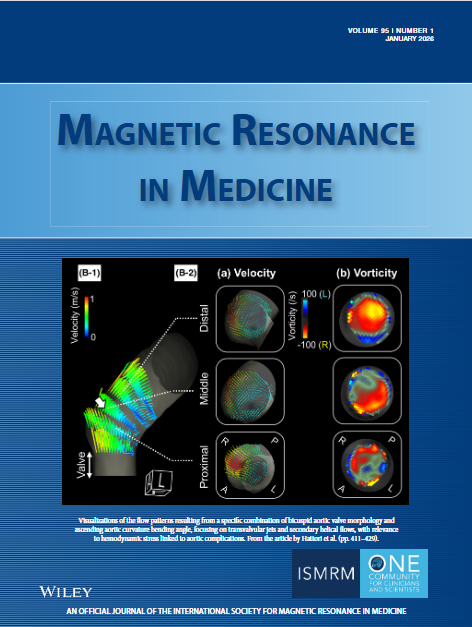
February’s Cover Art: This month’s cover art is from: 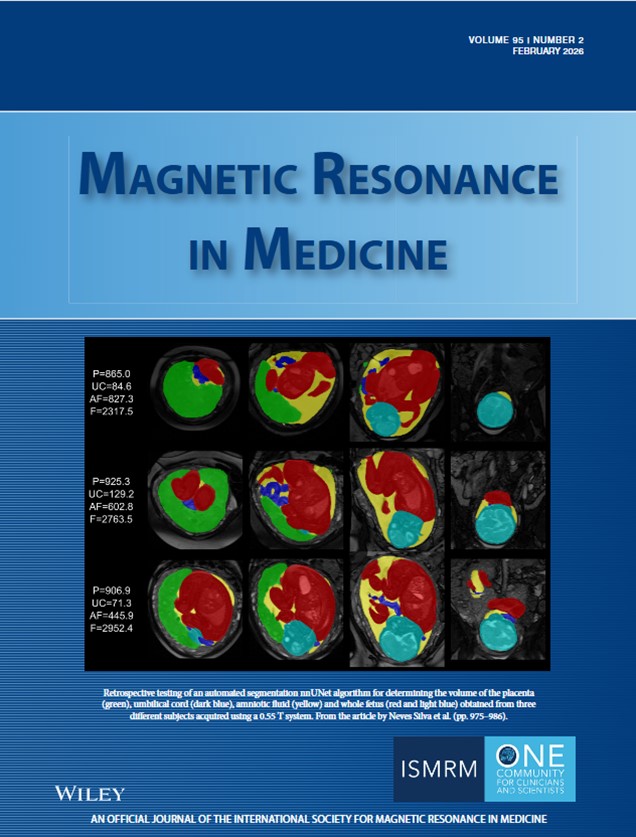
In vitro characterization of hemodynamics in bicuspid aortic valves: The impact of valve and ascending aortic morphologies, by Kaoru Hattori, Natsuki Nakama, Jumpei Takada, Michinobu Nagao, Yasuhiro Goto, Hiroshi Niinami, Kiyotaka Iwasaki
February’s Editor’s Picks: Each month, we highlight articles from the current issue that might be of particular interest to our readers. The articles will be available online to anyone for a period of two years, regardless of their subscription status. This month’s selections are:
- Advancing whole-brain BOLD functional MRI in humans at 10.5 T with motion-robust 3D echo-planar imaging, parallel transmission, and high-density radiofrequency receive coils, by Shuxian Qu, Jiaen Liu, Peter van Gelderen, Jacco A. de Zwart, Jeff H. Duyn, Matt Waks, Russell Lagore, Alexander Bratch, Andrea Grant, Edward Auerbach, Lance Delabarre, Alireza Sadeghi-Tarakameh, Yigitcan Eryaman, Gregor Adriany, Kamil Ugurbil, Xiaoping Wu
- Cartesian MaxGIRF: Model-based EPI reconstruction incorporating gradient nonlinearity and concomitant field effects, by Nam G. Lee, Sophia X. Cui, Krishna S. Nayak
- A unipolar head gradient for high-field MRI without encoding ambiguity, by Markus Weiger, Johan Overweg, Franciszek Hennel, Emily Louise Baadsvik, Samuel Bianchi, Oskar Björkqvist, Roger Luechinger, Jens Metzger, Eric Seth Michael, Thomas Schmid, Lauro Singenberger, Urs Sturzenegger, Erik Oskam, Gerrit Vissers, Jos Koonen, Wout Schuth, Jeroen Koeleman, Martino Borgo, Klaas Paul Pruessmann
- Rapid whole-brain T2* and susceptibility mapping using 3D multiple overlapping-echo detachment acquisition and missing modality synthesis embedded simulation, by Qinqin Yang, Longkun Chen, Nuowei Ge, Jie Chen, Jingying Yang, Zejun Wu, Chenyang Dai, Shuhui Cai, Zhong Chen, Lijun Bao, Liuhong Zhu, Jianfeng Bao, Congbo Cai
FEATURES
*The MRM Highlights Magazine, Volume 10, is available online!
YIA submissions for the 2027 ISMRM Annual Meeting in Vancouver, BC, Canada
The International Society for Magnetic Resonance in Medicine announces the competition for the Young Investigator Awards for the ISMRM & ISMRT Annual Meeting & Exhibition, in Vancouver, BC, Canada, 08-13 May 2027. The deadline to submit a manuscript for the competition is 11 September 2026. For more information about the YIA competition, please visit here.
Full Issue PDFs
Full Issue PDFs are now available for download. Please follow the link available at the journal home page. You will be prompted for your ISMRM login information.
LINKS OF INTEREST
February Articles
Early View
ISMRM Journal Page
Journal Home Page
Highlights Page
- Highlights Print Supplements, including:
- 2016, featuring Erwin Hahn’s interview
- 2017, featuring John Tanner’s interview
- 2018, featuring Al Macovski’s interview
- 2019, featuring Joanne Ingwall’s interview
- 2020, Virtual Issue, Volume 5
- 2021, Virtual Issue, Volume 6
- 2022, Virtual Issue, Volume 7
- 2023, Virtual Issue, Volume 8
- 2024, Virtual Issue, Volume 9
- 2025, Virtual Issue, Volume 10
Cover Gallery
Virtual Special Issues
YouTube Channel
Previous Editor’s Picks
Full Issue PDFs (ISMRM login required)